

Parenting Plans in Los Angeles: A Complete Guide for 2026
Few documents in a divorce or separation carry as much long-term weight as a parenting plan. This single agreement shapes where your children live, how decisions are made about their upbringing, and the rhythm of their daily lives for years to come. For parents in Los Angeles navigating this process, understanding both California law and the specific procedures of the LA Superior Court is essential.
At The Marsh Firm, we work with sophisticated families facing complex custody matters. Whether you are negotiating an agreement with your co-parent or preparing for court-ordered mediation, this guide explains what you need to know about parenting plans in Los Angeles.
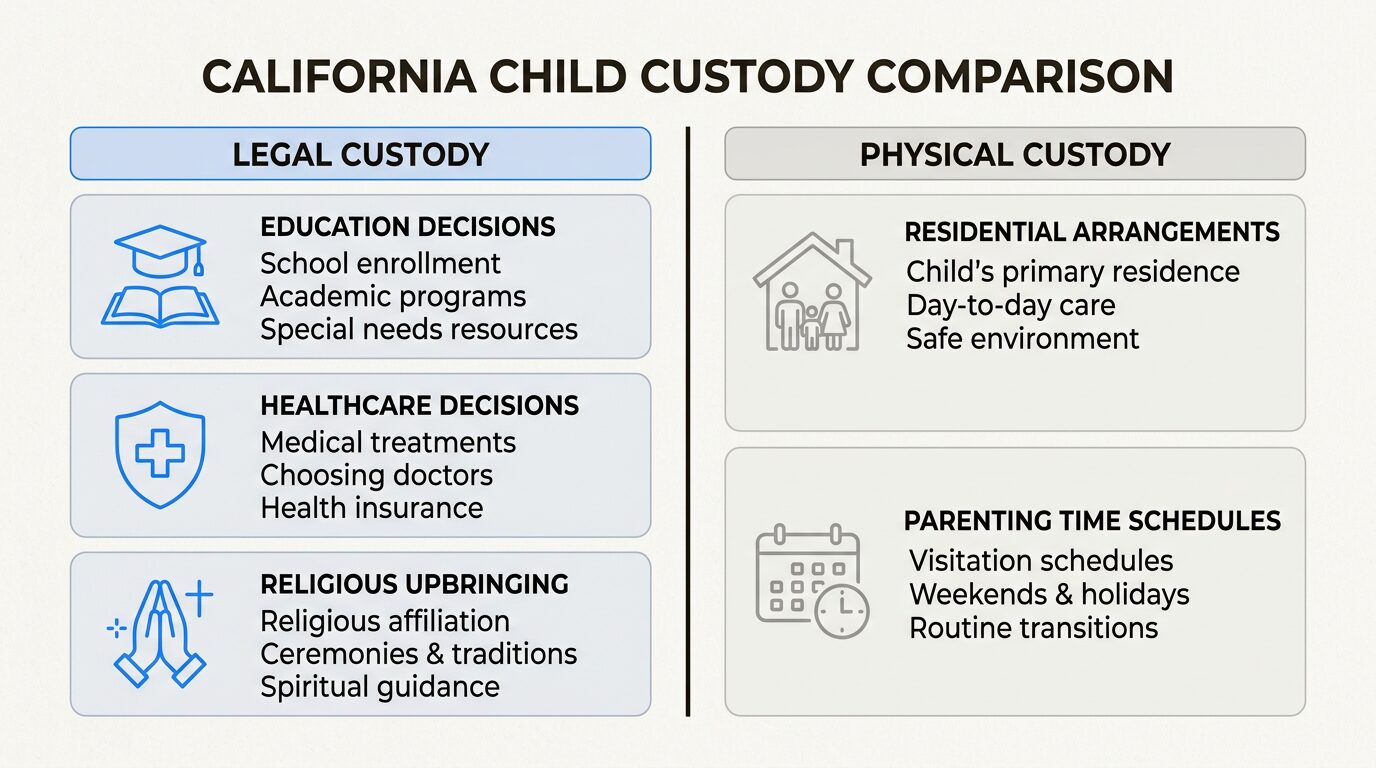
How Does the Los Angeles Superior Court Handle Parenting Plans?
While California law provides the framework, the Los Angeles Superior Court has specific procedures that parents must follow. Understanding these local requirements can help you navigate the process more effectively.
Family Court Services Mediation
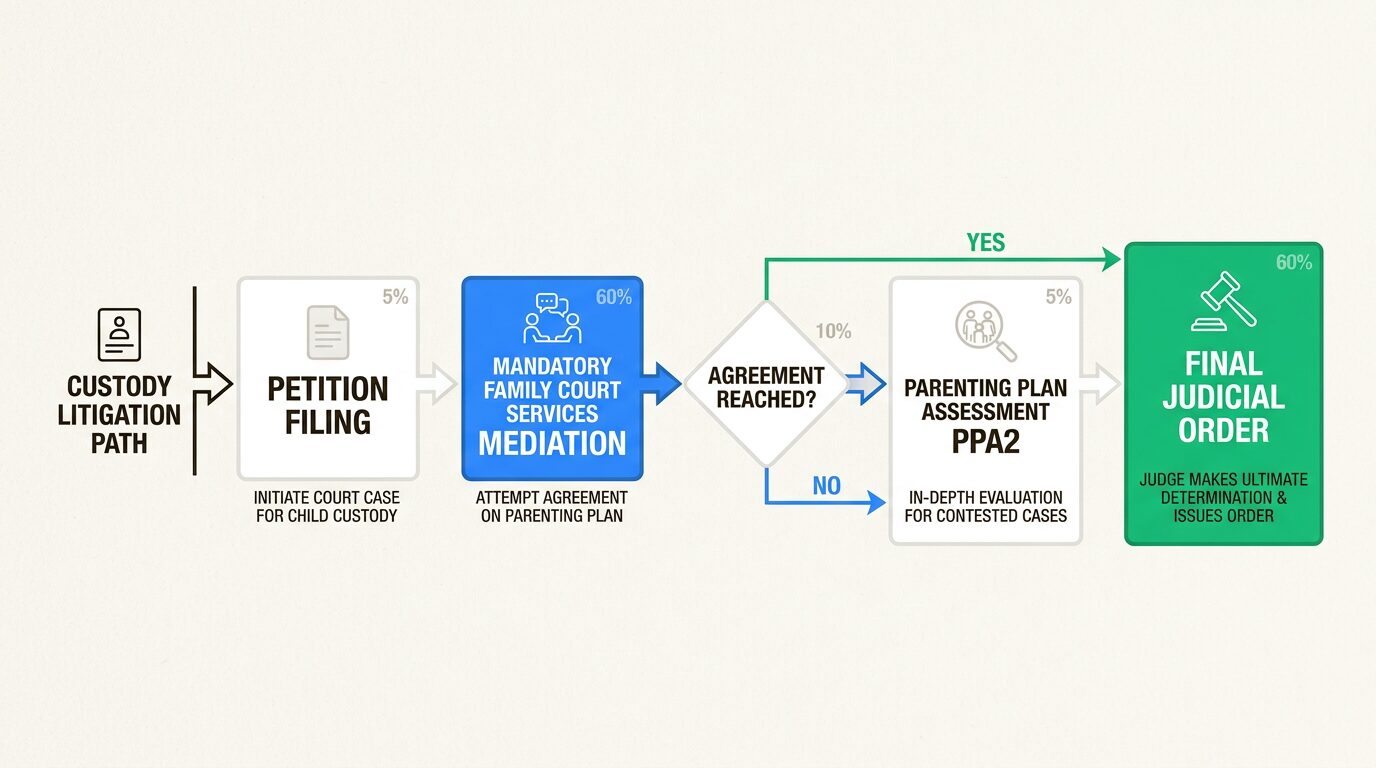
Before a judge will hear a contested custody case, parents in LA County must attend mediation through Family Court Services (FCS). This mandatory process gives parents an opportunity to reach agreement with the help of a neutral mediator.
Mediation sessions typically occur at the courthouse where your case is filed. The mediator, trained in both conflict resolution and child development, helps parents identify areas of agreement and explore options for resolving disputes. If parents reach an agreement during mediation, the mediator drafts a parenting plan for the judge to review and approve.
Not all mediations result in agreement. When parents cannot resolve their differences, the mediator may provide recommendations to the court based on their assessment of the child’s best interests. These recommendations carry significant weight with judges.
Parenting Plan Assessment (PPA2)
In contested cases where the court needs additional information, a judge may order a Parenting Plan Assessment, commonly called a PPA2. This two-day evaluation involves in-depth interviews and observations conducted by an FCS specialist.
The PPA2 process includes:
- Individual interviews with both parents
- Interviews with children aged 8 and older
- Family observation sessions where the specialist watches parent-child interactions
- Review of relevant documents such as school records or therapist reports
- Collateral contacts with individuals who have relevant information about the family
The cost for a PPA2 is $975 per parent, payable to the Family Law Clerk’s Office within 21 days of the court order. Late payment results in cancellation of the assessment. If your case settles before the assessment begins, you may receive a full refund by notifying the FCS office in advance.
After completing the evaluation, the FCS specialist presents recommendations at a hearing where both parents and their attorneys can ask questions. Judges typically give significant deference to these recommendations.
Filing Procedures in LA County
Parenting plan cases in Los Angeles are typically filed at the Stanley Mosk Courthouse downtown or at district courthouses throughout the county. The LA Superior Court provides a comprehensive parenting plan guide that includes templates and explanations of key concepts.
The California Courts Self-Help Center also offers resources for parents representing themselves, including form instructions and information about what to expect at each stage of the process.
For parents working with an attorney, your lawyer will handle filing procedures. However, understanding the basics helps you participate meaningfully in strategy discussions and anticipate next steps.
What Should Your Parenting Plan Include?
A comprehensive parenting plan addresses far more than simply which days the children spend with each parent. The most effective plans anticipate potential conflicts and establish clear protocols for handling them.
Regular Parenting Time Schedule
The weekly schedule forms the backbone of any parenting plan. Common arrangements include:
- Alternating weeks: Children spend one full week with each parent
- 2-2-3 schedule: Parent A has Monday-Tuesday, Parent B has Wednesday-Thursday, parents alternate Friday-Sunday
- Weekends plus midweek: One parent has weekdays, the other has weekends plus one midweek evening
- Primary custody with visitation: One parent has primary physical custody, the other has scheduled visitation
The best schedule depends on your children’s ages, the distance between homes, school locations, and each parent’s work commitments. What works for a toddler rarely works for a teenager.
Your plan should also specify exchange times and locations, who provides transportation, and how to handle delays or schedule changes. The more detail you include now, the fewer disputes you will face later.
Holiday and Vacation Schedules
Holidays are a frequent source of conflict when plans lack specificity. Your parenting plan should address:
- Major holidays: Thanksgiving, Christmas, New Year’s, and other significant dates
- Religious and cultural observances: Important to your family’s traditions
- School breaks: Winter break, spring break, and summer vacation
- Birthdays: Both children’s and parents’ birthdays
Most plans alternate holidays year to year (Parent A has Thanksgiving in even years, Parent B in odd years) or split them (one parent has Christmas Eve, the other has Christmas Day). Summer vacation often gets divided into blocks of one or two weeks.
Include exact start and end times for each holiday period. “Christmas break starts when school dismisses” is clearer than “Christmas break starts Friday.”
Decision-Making Protocols
Beyond custody labels, effective plans specify how decisions are actually made. Consider including:
- Day-to-day decisions: Each parent makes routine decisions during their parenting time
- Major decisions: Both parents must agree on significant choices, or one parent has final authority
- Emergency medical authority: Either parent can consent to emergency treatment
- Educational choices: School enrollment, tutoring, special education services
- Extracurricular activities: How activities are selected and who pays for them
Some families benefit from designating specific decision-making areas to each parent based on their strengths and involvement. A parent who has always handled medical appointments might retain primary authority in that area while sharing other decisions.
Communication Guidelines
Clear communication rules prevent many common co-parenting conflicts. Your plan might specify:
- Approved methods: Email, text, phone calls, or co-parenting apps like OurFamilyWizard or TalkingParents
- Response time expectations: How quickly parents must reply to non-emergency communications
- Information sharing: What each parent must tell the other about the child’s activities, health, and school
- Communication with the child: When and how the child can contact the other parent during visits
For high-conflict situations, restricting communication to co-parenting apps that document all exchanges can reduce disputes. These apps create records that courts can review if conflicts arise.
Special Considerations for High-Net-Worth Families
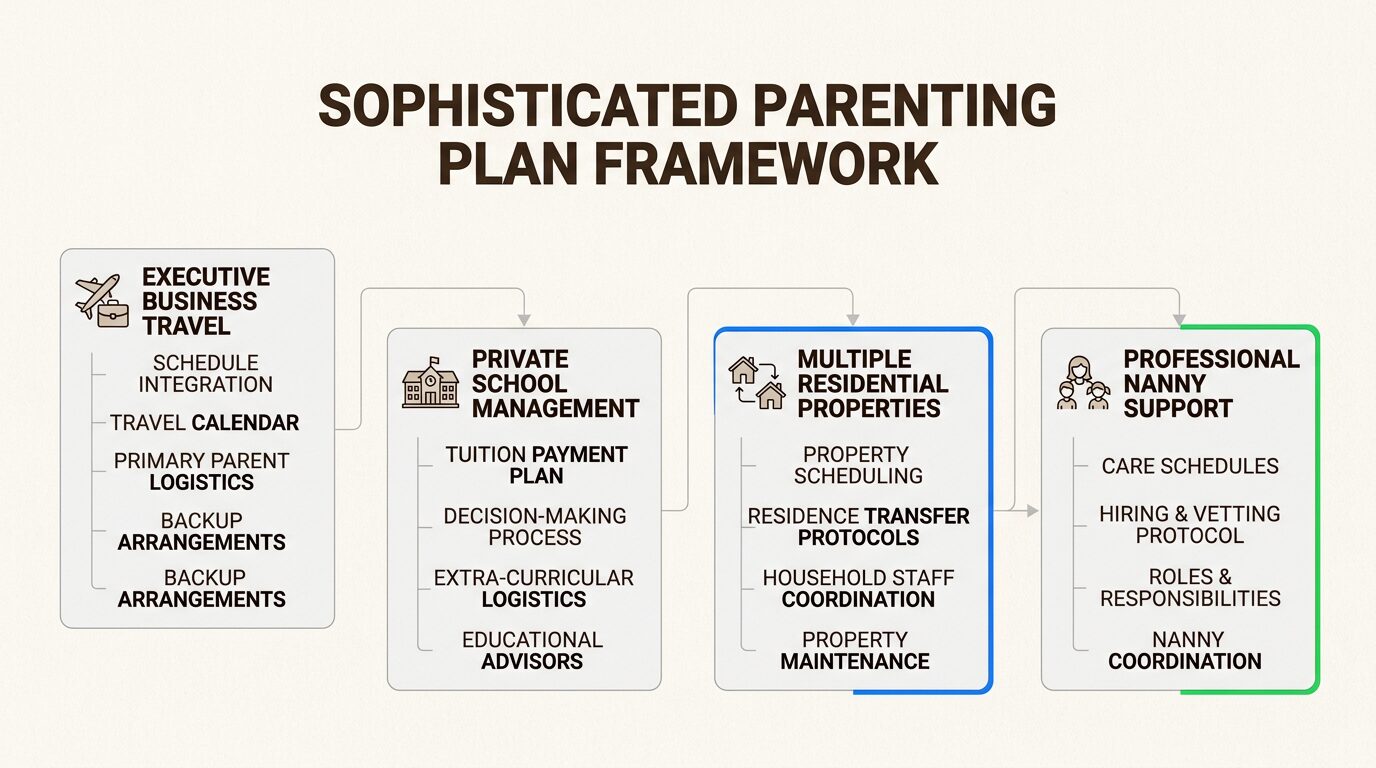
Standard parenting plan templates often fail to address the realities faced by sophisticated Los Angeles families. At The Marsh Firm, we regularly work with clients whose situations require customized provisions.
Complex Scheduling Needs
Executives, entrepreneurs, and professionals with demanding careers need flexibility built into their parenting plans. A CEO who travels frequently for business requires different provisions than a parent with a predictable 9-to-5 schedule.
Consider including:
- Make-up time provisions: When work obligations conflict with scheduled parenting time
- Right of first refusal nuances: For families with nannies or household staff
- Advance notice requirements: For business travel that affects the schedule
- Virtual visitation: Video calls when a parent is traveling
Parents with multiple residences (a primary home in Beverly Hills, a weekend property in Montecito, for example) need plans that address where children spend time at each property and how transitions between homes work.
Educational Planning
Families considering private school or planning for college need provisions addressing:
- School selection: How parents choose between competing school options
- Tuition responsibility: Who pays for private school and how costs are shared
- Educational consultant involvement: When outside experts help with school placement or college admissions
- Special needs accommodations: How educational decisions are made for children with learning differences
Some families designate one parent as having primary authority over educational decisions while requiring consultation with the other. Others require joint agreement on major educational choices.
Professional Support Integration
High-net-worth families often work with various professionals supporting their children’s wellbeing. Your parenting plan should address:
- Therapeutic relationships: How information is shared between parents and family therapists
- Reunification therapy: Protocols when a parent and child need therapeutic support rebuilding their relationship
- Medical providers: How parents coordinate with pediatricians, specialists, and other healthcare providers
- Los Angeles-area resources: Specific therapists, programs, or services in the LA area
The plan should specify whether both parents can attend therapy sessions, how therapeutic information is shared, and who has authority to consent to treatment.
Age-Specific Parenting Plan Strategies
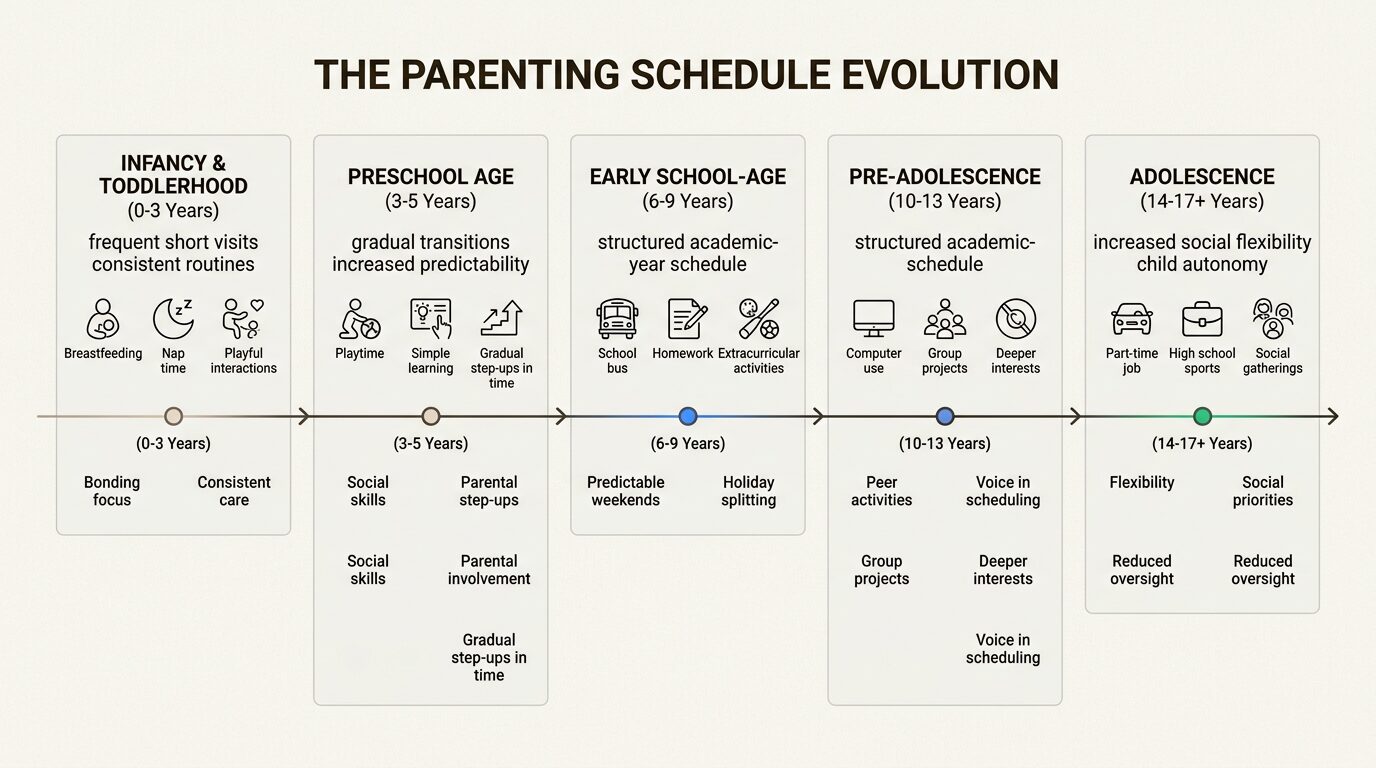
Children’s needs change dramatically as they grow. A plan that works for a toddler will likely need revision by elementary school, and again by middle school.
Infants and Toddlers (0-3 years)
Young children need frequent contact with both parents to build secure attachments. However, they also need consistency and routine. Plans for this age group typically feature:
- Short, frequent visits: Several brief visits per week rather than long stretches away from either parent
- Breastfeeding accommodations: Schedules that work around nursing needs
- Gradual transitions: Step-up plans that increase time as the child grows more comfortable
- Detailed caregiving information: How parents share information about feeding, sleep, and routines
The Los Angeles Superior Court Family Court Services suggests visitation schedules that allow the non-residential parent two to three hours per day, three days per week for infants, gradually increasing as the child develops.
School-Age Children (5-12 years)
As children enter school, their schedules become more structured and their social worlds expand. Effective plans for this age group address:
- Academic calendar coordination: How parents handle teacher conferences, school events, and homework responsibilities
- Extracurricular management: Who transports to activities and how costs are shared
- Social development: How parents handle playdates, sleepovers, and peer relationships
- Consistency across households: Similar bedtimes, rules, and expectations at both homes
Children this age benefit from predictable schedules they can count on. They also need flexibility for school events, sports, and activities that may conflict with the regular parenting schedule.
Teenagers (13+ years)
Teenagers present unique challenges for parenting plans. Their schedules are complex, their social lives are intense, and their preferences carry increasing weight with courts.
Plans for teenagers should consider:
- Their input: Courts increasingly consider teenagers’ preferences about where they live
- Academic and social demands: High school schedules, part-time jobs, and college preparation
- Driving and independence: How parents handle a teenager’s growing autonomy
- Flexibility: Rigid schedules often fail with teenagers who have legitimate competing demands
By this age, many families transition to plans that specify minimum time with each parent while allowing teenagers flexibility to manage their own schedules within those parameters.
Modifying Parenting Plans in Los Angeles
Life changes, and parenting plans sometimes need to change with it. California courts will modify custody orders when there has been a significant change in circumstances affecting the child’s best interests.
Common reasons for modification include:
- Relocation: One parent needs to move for work or personal reasons
- Schedule changes: A parent’s work schedule changes substantially
- Child’s evolving needs: As children grow, their needs and preferences change
- Safety concerns: Evidence that the current arrangement puts the child at risk
- Non-compliance: One parent consistently fails to follow the existing plan
The modification process in Los Angeles follows similar procedures to initial custody determinations. Parents must file a request with the court, attend mediation through Family Court Services, and potentially appear before a judge if agreement cannot be reached.
Courts generally require a showing that the proposed modification serves the child’s best interests and that circumstances have changed significantly since the original order was entered. Minor inconveniences or preferences rarely justify modifications.
Creating a Parenting Plan That Works for Your Family
The best parenting plans are detailed enough to prevent disputes but flexible enough to accommodate real life. They prioritize the child’s wellbeing over parental convenience while respecting both parents’ relationships with their children.
At The Marsh Firm, we approach parenting plans strategically. We help clients think through scenarios they might not have considered, negotiate effectively with their co-parent, and create plans that serve their family’s unique needs. For high-net-worth families, this often means addressing complex scheduling, educational planning, and professional coordination that standard templates simply do not cover.
If you are facing custody decisions in Los Angeles, we can help. Our team brings clarity, composure, and strategic thinking to complex family law matters. You can request a private consultation today to discuss your situation and learn how we can help you create a parenting plan that protects your children and your parental rights.
Frequently Asked Questions
How long does it take to establish parenting plans in Los Angeles?
The timeline varies significantly based on whether parents agree or contest custody. If both parents reach agreement through mediation, a plan can be approved within weeks. Contested cases requiring PPA2 assessments or custody evaluations often take 6-12 months or longer.
Do mothers automatically get primary custody in Los Angeles parenting plans?
No. California law prohibits gender bias in custody decisions. Courts focus on the child’s best interests, considering factors like each parent’s relationship with the child, ability to provide care, and history of involvement. Both mothers and fathers can be awarded primary physical custody or joint custody.
Can parenting plans in Los Angeles be changed without going to court?
Parents can agree to modify their plan informally, but informal changes are not legally enforceable. To make modifications binding, parents must submit a stipulation to the court for approval or obtain a new court order. Without court approval, either parent can revert to the original order at any time.
What happens if one parent violates parenting plans in Los Angeles?
Violations can be addressed through the court system. The parent seeking enforcement can file a motion asking the court to hold the violating parent in contempt or modify the order to prevent future violations. Courts may impose penalties, attorney fee awards, or even change custody arrangements for serious or repeated violations.
How much does it cost to create parenting plans in Los Angeles with an attorney?
Costs vary based on complexity and whether the case is contested. Uncontested cases where parents agree on all terms require less attorney time than contested cases involving PPA2 assessments, custody evaluations, or litigation. At The Marsh Firm, we discuss fees transparently during initial consultations and work efficiently to control costs while protecting your interests.
At what age can children decide which parent to live with in Los Angeles parenting plans?
California law does not specify an age at which children can choose their custodial parent. Courts must consider the preferences of children mature enough to make an intelligent choice, with older teenagers’ preferences typically carrying more weight. However, a child’s preference is just one factor among many that courts consider in determining the child’s best interests.