

Determining Your Date of Separation and Why It Matters in Your California Divorce
Your date of separation is the day your marriage ended under California law. This date marks the precise moment when property and earnings shift from community property (shared) to separate property (individual), directly impacting how assets and debts are divided in your divorce. Under California Family Code § 70, courts determine this date by evaluating whether one spouse communicated intent to end the marriage and whether their conduct aligned with that intent. For high-net-worth individuals in Los Angeles, an accurate separation date can mean the difference between preserving significant assets or watching them become subject to equal division.
How Does California Law Define the Date of Separation?
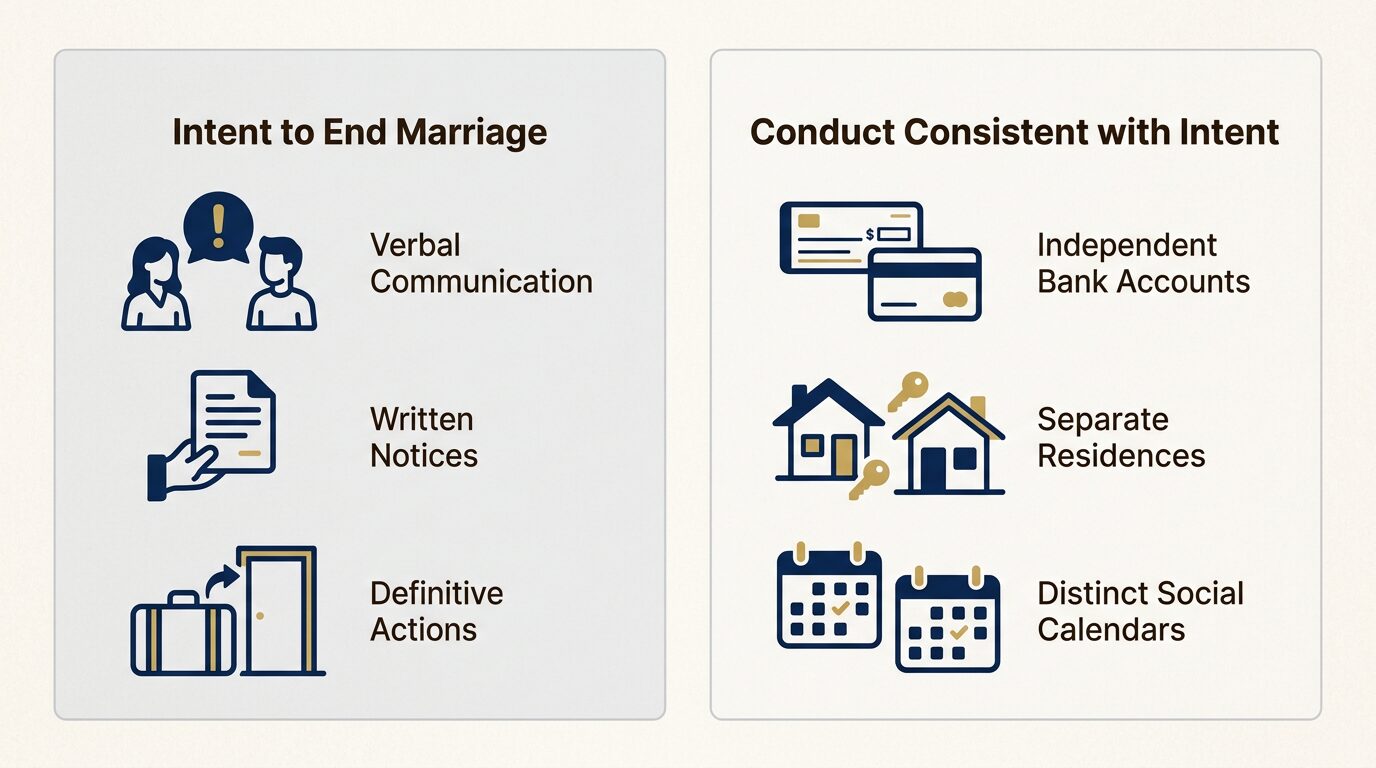
California Family Code § 70 defines the date of separation as the date when a “complete and final break in the marital relationship” has occurred, as shown by a spouse’s expressed intent to end the marriage and conduct consistent with that intent.
This definition represents a significant shift in California law. Before 2017, the California Supreme Court’s decision in Marriage of Davis required spouses to live in separate residences to establish a legal separation. This created real problems for couples who couldn’t afford two households or who chose to remain under one roof for their children’s stability.
The legislature responded by enacting Family Code § 70, which explicitly abrogated Davis and its predecessor Marriage of Norviel. Now, physical separation is just one factor among many. A couple can be legally separated while sharing the same address if their lives have diverged in meaningful ways.
The two-prong test courts apply is straightforward in concept but often complex in application. First, one spouse must have communicated to the other an intent to end the marriage. This communication can be explicit (“I want a divorce”) or demonstrated through clear actions. Second, that spouse’s conduct must be consistent with the intent to separate. Living separate lives, managing finances independently, and ceasing marital activities all demonstrate this consistency.
In our practice at The Marsh Firm, we’ve seen cases where the difference between a separation date in January versus June resulted in millions of dollars shifting between community and separate property. The law is clear. Pinpointing the date requires careful analysis of the facts.
What Evidence Do California Courts Consider?
California courts evaluate the totality of circumstances when determining the date of separation, examining financial, residential, social, and communicative evidence to establish when the marital relationship truly ended.
No single factor is determinative. Judges look for patterns that demonstrate a fundamental shift in the nature of the relationship. The evidence that carries the most weight typically shows a clear break in how the spouses conducted their lives together.
Financial separation is often the strongest indicator. When spouses close joint accounts, stop sharing credit cards, or begin paying expenses separately, they are demonstrating that their economic lives have diverged. Courts examine bank statements, credit card records, and tax filings to trace when finances separated.
Communications matter significantly. Text messages, emails, or letters where one spouse clearly states the marriage is over can establish the date of intent. Social media posts announcing a separation, while less formal, can also support a claimed date.
Changes in living arrangements within the home carry weight too. Moving into separate bedrooms, establishing distinct household responsibilities, and ceasing intimate relations all demonstrate that the marital relationship has ended even if the address hasn’t changed.
Courts also consider whether the spouses continued presenting themselves as married to friends, family, and colleagues. Telling others about the separation, attending events separately, and discontinuing joint social activities all support an earlier separation date.
Los Angeles County Superior Court Considerations
When filing in Los Angeles County, separation date disputes are typically heard at the Stanley Mosk Courthouse downtown or at district courthouses in Van Nuys, Pasadena, or other locations depending on where you reside. LA Family Court judges see a high volume of these disputes and expect well-documented evidence.
In our experience handling cases from Beverly Hills to Santa Monica to Downtown LA, we’ve found that local judges pay particular attention to financial separation documentation. The high cost of living in Los Angeles means many couples continue cohabitating for financial reasons, making financial records often the clearest evidence of when the marriage actually ended.
How Does the Date of Separation Affect Property Division?
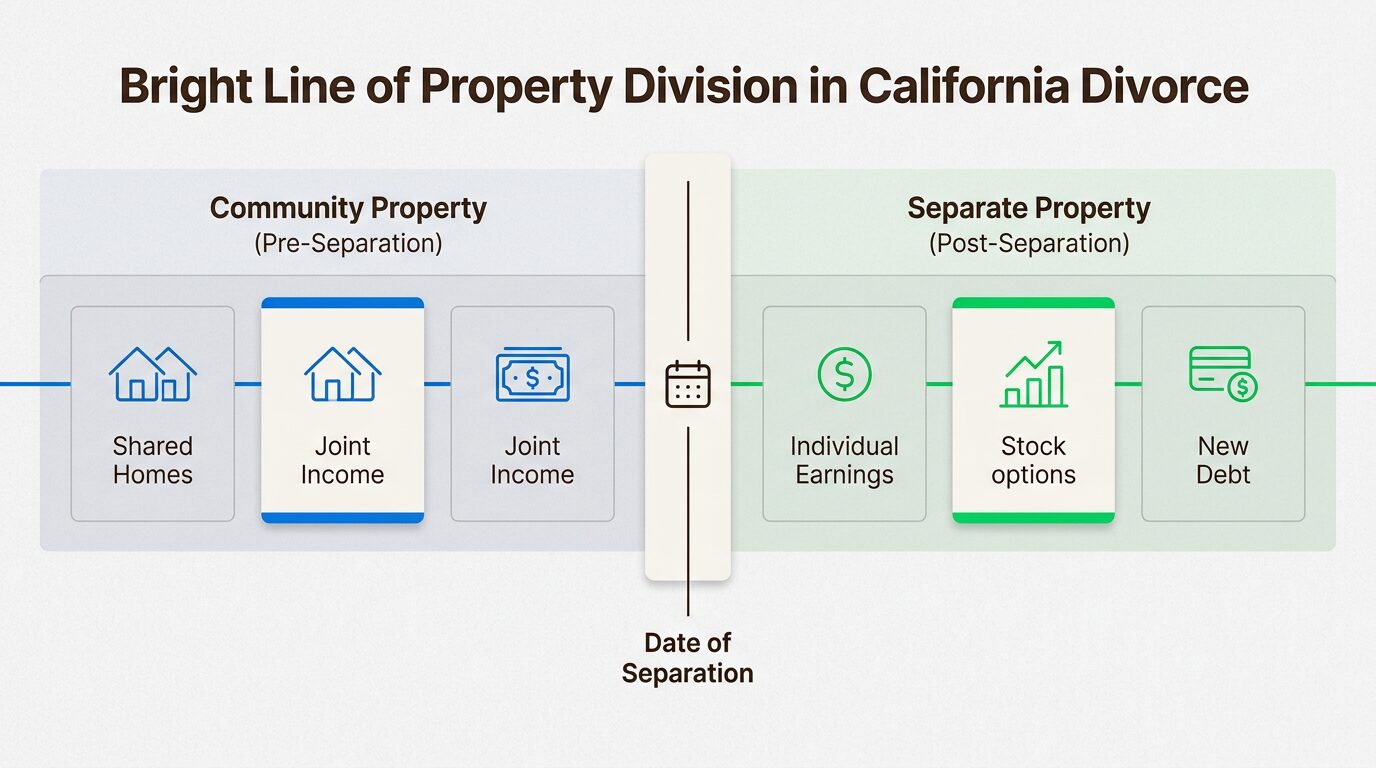
The date of separation creates a bright line for property classification in California: assets and debts acquired before this date are community property subject to equal division, while those acquired after are separate property belonging to the individual spouse.
California is a community property state. Under Family Code § 760, all property acquired during marriage is presumed community property, owned equally by both spouses regardless of who earned it or whose name is on the title. This presumption continues until the date of separation.
Once the separation date is established, the community property estate stops growing. Any income earned, assets purchased, or debts incurred after this date are the separate property or obligation of the spouse who acquired them. This distinction fundamentally shapes the financial outcome of divorce.
For example, if a spouse receives a substantial bonus six months after the separation date, that bonus is their separate property. If they purchase real estate after separation using separate funds, that property remains theirs. The same rules apply to debts. A credit card opened after separation belongs to the spouse who opened it.
The practical impact is enormous in high-asset divorces. Stock options vesting after separation, business appreciation occurring post-separation, and investment gains accumulated after the marriage ends all potentially remain separate property. Getting the date right protects what you’ve built.
Special Considerations for High-Net-Worth Divorces
In high-net-worth divorces, the date of separation affects complex assets including RSUs, stock options, executive compensation, business valuations, and real estate appreciation, often involving millions of dollars in property classification.
Restricted Stock Units (RSUs) and stock options create particular complexity. These equity awards often vest over time, with portions vesting before separation (community property) and portions vesting after (separate property). The allocation requires careful tracing of grant dates, vesting schedules, and the relationship between vesting and employment during marriage.
Executive compensation structures add another layer. Bonuses tied to performance periods that span the separation date, deferred compensation plans, and carried interest in investment funds all require analysis of when the right to payment was earned versus when it was paid.
For business owners, the date of separation can affect whether post-separation appreciation in company value is community or separate property. If the business grows significantly after separation due to market forces or the owner’s individual efforts, that growth may be separate property. Proving this requires business valuation experts and forensic accountants.
Real estate in Los Angeles presents unique considerations. Under Moore and Marsden, when separate property funds are used to pay down mortgage principal on a community property home, the contributing spouse may be entitled to reimbursement. The date of separation affects calculations of community versus separate property equity.
Trust distributions and separate property tracing also hinge on separation timing. Inheritances received after separation are clearly separate property, but tracing commingled funds requires sophisticated forensic analysis.
Silicon Beach and Entertainment Industry Asset Nuances
Los Angeles has unique asset profiles that make separation date critical. In Santa Monica, Venice, and the broader Silicon Beach area, tech workers often hold significant equity in startups. A separation date just before or after a liquidity event can determine whether millions in proceeds are community or separate property.
Similarly, entertainment industry professionals may have residual streams, royalty payments, and intellectual property rights that generate income long after the work was created. The date of separation affects whether post-separation residuals from work done during marriage are community or separate property.
How Does the Date of Separation Impact Spousal Support?
The date of separation stops the clock on marriage duration, which directly affects spousal support calculations because marriages lasting ten years or more are considered “long-term” and may result in indefinite support obligations.
California Family Code § 4320 lists the factors courts consider when awarding spousal support. Marriage duration is among the most significant. Short-term marriages (under 10 years) typically result in support lasting roughly half the marriage length. Long-term marriages (10+ years) have no presumptive end date.
This creates strategic implications. A separation date that pushes the marriage duration just under or over ten years can dramatically change support expectations. Courts look at the total time from wedding to separation, not from wedding to divorce filing or final judgment.
The separation date also affects the parties’ financial circumstances at the time support is determined. If one spouse’s income increased significantly after separation, that post-separation income may be considered in support calculations differently than if the increase occurred during marriage.
In our practice, we’ve advised clients on the timing of separation declarations when the ten-year mark is approaching. While courts look at the actual date the relationship ended, not when someone decides to claim it ended, understanding these thresholds helps clients make informed decisions about their financial futures.
What Happens When Spouses Disagree on the Separation Date?
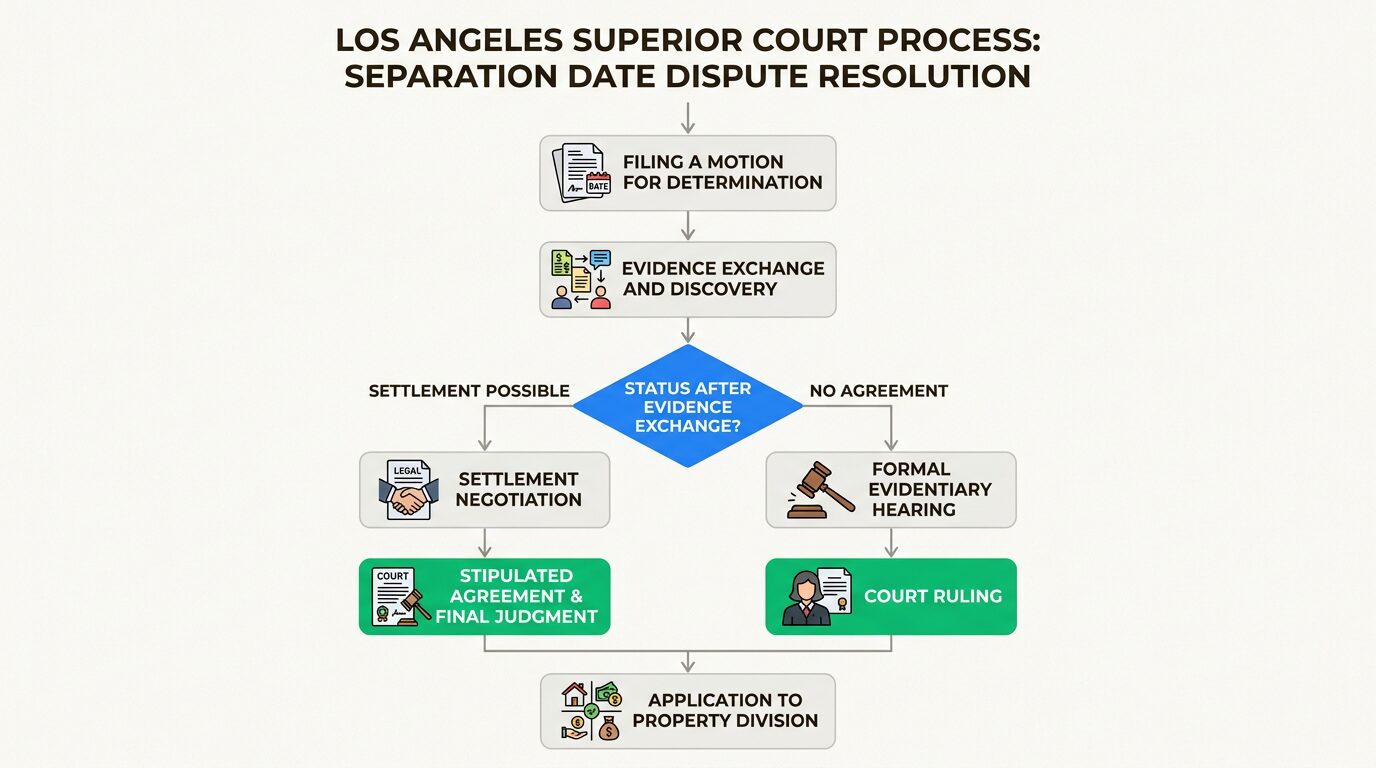
When spouses disagree on the date of separation, California courts conduct an evidentiary hearing to evaluate all available evidence and determine when the complete and final break in the marital relationship actually occurred.
Disputes commonly arise in several scenarios. Some couples live apart for work or other reasons before deciding to divorce, creating ambiguity about when the separation became permanent. Others continue cohabitating for financial reasons or child-rearing convenience, making the separation date less clear. Attempted reconciliations can reset the clock, requiring courts to determine whether the reconciliation was genuine and when the final separation occurred.
The burden of proof falls on the party claiming the earlier separation date. This requires presenting credible evidence of intent and conduct consistent with that intent. Documentation is critical. Financial records showing separate accounts, communications demonstrating the intent to divorce, and witness testimony about the couple’s living situation all support a claimed date.
Forensic accountants often play a key role in these disputes. They trace financial separation, analyzing when joint accounts were closed, when expenses stopped being shared, and when financial lives truly diverged. This financial evidence often carries more weight than testimony about emotional states.
Courts can bifurcate trials to resolve separation date disputes before addressing other issues. This approach makes sense when the date affects significant assets. Rather than litigating everything at once, the court first determines the separation date, then applies that date to property division and support calculations.
| Evidence Type | Weight with Courts | Documentation Needed |
|---|---|---|
| Physical move-out | Strong | Lease agreements, utility bills, change of address records |
| Financial separation | Very Strong | Bank statements showing separate accounts, credit card records, canceled joint accounts |
| Written communication | Strong | Text messages, emails, letters expressing intent to divorce |
| Social media posts | Moderate | Screenshots with timestamps showing separation announcements |
| Witness testimony | Moderate | Declarations from friends, family, or colleagues who observed the separation |
| Separate tax filing | Strong | Tax returns showing married filing separately or single status |
This complex process is exactly how we approach cases at The Marsh Firm to ensure no detail is overlooked. We work with forensic accountants to trace financial separation, gather documentary evidence, and present a clear, compelling case for our client’s claimed date. If you are facing a dispute over your date of separation, you can request a private consultation today to get started with expert legal guidance tailored to your situation.
Navigating the Los Angeles County Legal System
Filing for divorce in Los Angeles County requires submitting initial pleadings to the Superior Court, completing financial disclosure forms, and potentially appearing at the Stanley Mosk Courthouse or district courthouses in Van Nuys, Pasadena, or other locations depending on your residence.
LA County has specific local rules governing family law proceedings. Financial disclosures must be completed using standardized forms (FL-142 for asset declarations, FL-150 for income and expense declarations) and served on the opposing party within specific timeframes. Failure to properly complete these disclosures can result in sanctions and affect credibility on separation date disputes.
The court system encourages settlement through mandatory settlement conferences and mediation. However, when separation date is genuinely disputed, these issues often require judicial determination. Having experienced counsel familiar with LA Family Court procedures ensures your case proceeds efficiently.
Timeline expectations vary. Uncontested divorces with agreed separation dates can resolve in six months. Disputed separation date cases involving complex assets may take 12-24 months or longer, particularly if forensic accounting and business valuation are required.
Working with local professionals who understand the LA market is essential. Real estate valuations, business appraisals, and forensic accounting all require experts familiar with Los Angeles economic conditions.
Local Professional Network in Los Angeles
At The Marsh Firm, we maintain relationships with trusted forensic accountants in Century City and Beverly Hills who specialize in tracing complex financial histories. For business valuations, we work with experts familiar with Silicon Beach tech companies, entertainment industry valuations, and professional practice appraisals.
When documentation of living situations is needed, we coordinate with private investigators who understand the sensitivities of high-profile cases. This network ensures our clients have access to the specialized expertise their cases require.
How Can You Protect Your Financial Interests Around the Separation Date?
Protecting your financial interests requires documenting the date you communicated intent to end the marriage, preserving all financial records and communications, avoiding conduct that suggests the marriage continues, and consulting experienced counsel before making major financial decisions.
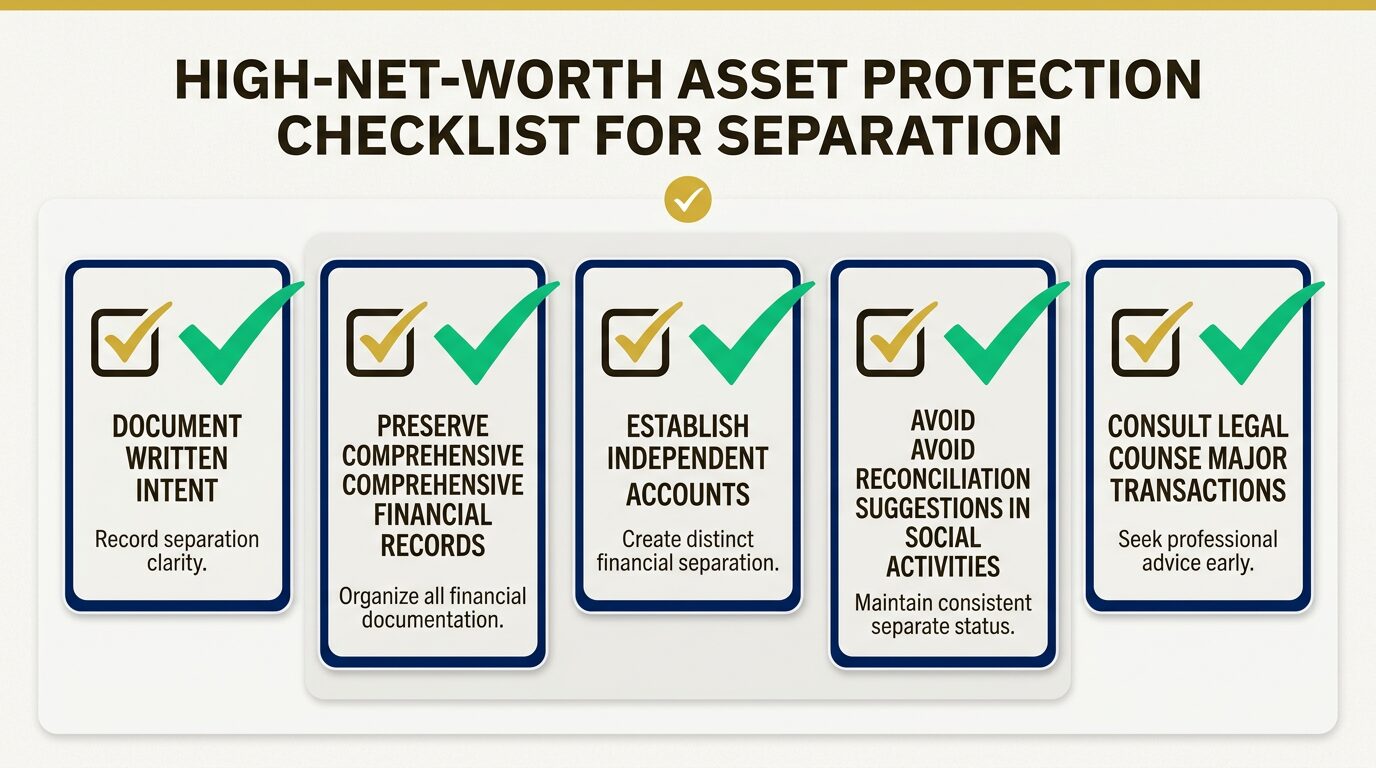
Documentation should begin immediately when you decide the marriage is over. Send a clear written communication to your spouse stating your intent to divorce. Save copies of this communication. Begin keeping a timeline of significant events and decisions.
Financial records are critical. Gather bank statements, credit card records, investment account statements, and tax returns from the past several years. If you don’t have access to joint accounts, document your efforts to obtain this information. Once you separate finances, maintain meticulous records of all transactions.
Avoid actions that blur the separation line. Continuing to file joint tax returns, taking vacations together, or presenting as a married couple to friends and family can undermine your claimed separation date. Social media posts showing continued marital activities can be used against you.
Consult counsel before making major financial moves. Large purchases, significant debt, or changes to beneficiary designations after separation can create complications. Your attorney can advise on how to protect your interests while avoiding actions that appear retaliatory or improper.
For complex asset portfolios, engage forensic accountants early. They can trace separate property contributions, analyze commingling issues, and provide expert testimony if the separation date is disputed. Proactive planning prevents problems later.
Frequently Asked Questions
Can you be separated while living in the same house in California?
Yes. Under California Family Code § 70, physical separation is not required to establish a legal date of separation. Courts look at whether there has been a complete and final break in the marital relationship, demonstrated by intent to end the marriage and conduct consistent with that intent. Many couples continue living under the same roof for financial reasons or child-rearing convenience while being legally separated.
What if my spouse and I disagree on when we separated?
When spouses disagree on the date of separation, the court conducts an evidentiary hearing to evaluate all available evidence. The party claiming the earlier date bears the burden of proof. Courts examine financial records, communications, witness testimony, and conduct to determine when the marital relationship actually ended. Having documented evidence of your claimed date is essential.
Does the date of separation affect who gets the house in a divorce?
The date of separation can significantly affect how the marital home is divided. Mortgage principal payments made after separation using separate funds may be reimbursable. Appreciation in the home’s value after separation may be allocated differently than appreciation during the marriage. Under Moore and Marsden, separate property contributions to the home may also affect division.
How do I prove my date of separation to the court?
Proving your date of separation requires documentary evidence. Gather financial records showing when accounts were separated, communications expressing intent to divorce, lease agreements or utility bills if you moved out, and witness statements from people who observed your separation. The more documentation you have, the stronger your position.
Can we agree on a separation date without going to court?
Yes. Spouses can stipulate to a date of separation by agreement, which should be documented in a written settlement agreement or stipulated court order. This approach avoids the cost and uncertainty of litigation. However, both parties should consult independent counsel before agreeing to ensure the date is fair and accurately reflects the circumstances.
Next Steps: Protecting Your Financial Future in a Los Angeles Divorce
The date of separation is not a technicality. It is a fundamental determination that shapes the entire financial landscape of your divorce. For high-net-worth individuals in Los Angeles, getting this date right can protect millions in assets, business interests, and future earnings.
At The Marsh Firm, we focus on complex property division for sophisticated clients. We understand that divorce is not just a legal transaction. It is a transition that requires strategic thinking, meticulous preparation, and an unwavering focus on what actually matters: your family’s long-term well-being.
Our approach combines legal expertise with emotional intelligence. We do not manufacture drama or pursue conflict for its own sake. We believe the best outcomes are achieved through intelligent negotiation backed by thorough preparation. When separation date disputes arise, we build compelling cases supported by forensic analysis and documentary evidence.
If you are facing a divorce in Los Angeles and have questions about your date of separation, we invite you to request a private consultation. We will listen to your situation, assess your assets, and provide an honest assessment of the path forward. The decisions you make now will affect your financial future for years to come. Having the right guidance makes all the difference.
Frequently Asked Questions
Can you be separated while living in the same house in California?
Yes. Under California Family Code § 70, physical separation is not required to establish a legal date of separation. Courts look at whether there has been a complete and final break in the marital relationship, demonstrated by intent to end the marriage and conduct consistent with that intent. Many couples continue living under the same roof for financial reasons or child-rearing convenience while being legally separated.
What if my spouse and I disagree on when we separated?
When spouses disagree on the date of separation, the court conducts an evidentiary hearing to evaluate all available evidence. The party claiming the earlier date bears the burden of proof. Courts examine financial records, communications, witness testimony, and conduct to determine when the marital relationship actually ended. Having documented evidence of your claimed date is essential.
Does the date of separation affect who gets the house in a divorce?
The date of separation can significantly affect how the marital home is divided. Mortgage principal payments made after separation using separate funds may be reimbursable. Appreciation in the home’s value after separation may be allocated differently than appreciation during the marriage. Under Moore and Marsden, separate property contributions to the home may also affect division.
How do I prove my date of separation to the court?
Proving your date of separation requires documentary evidence. Gather financial records showing when accounts were separated, communications expressing intent to divorce, lease agreements or utility bills if you moved out, and witness statements from people who observed your separation. The more documentation you have, the stronger your position.
Can we agree on a separation date without going to court?
Yes. Spouses can stipulate to a date of separation by agreement, which should be documented in a written settlement agreement or stipulated court order. This approach avoids the cost and uncertainty of litigation. However, both parties should consult independent counsel before agreeing to ensure the date is fair and accurately reflects the circumstances.