

Los Angeles Spousal Support Calculator: How Los Angeles Courts Calculate Alimony | A Guide to California Spousal Support in 2026
Los Angeles spousal support calculations (also known in Los Angeles as alimony) follow a two-tiered system that catches many people off guard. During active divorce proceedings, courts rely on mathematical formulas to determine temporary support. But once the divorce is finalized, those formulas disappear. In their place, judges weigh 14 statutory factors that leave substantial room for interpretation.
This distinction matters enormously, particularly for high net-worth individuals facing divorce in Los Angeles. The difference between temporary and permanent support can amount to tens of thousands of dollars monthly. Understanding how each calculation works, and what factors actually drive the outcomes, gives you the clarity to make informed decisions about your case.
This guide explains both calculation methods, the 10-year marriage milestone that changes everything, and what high net-worth individuals specifically need to understand about the process.
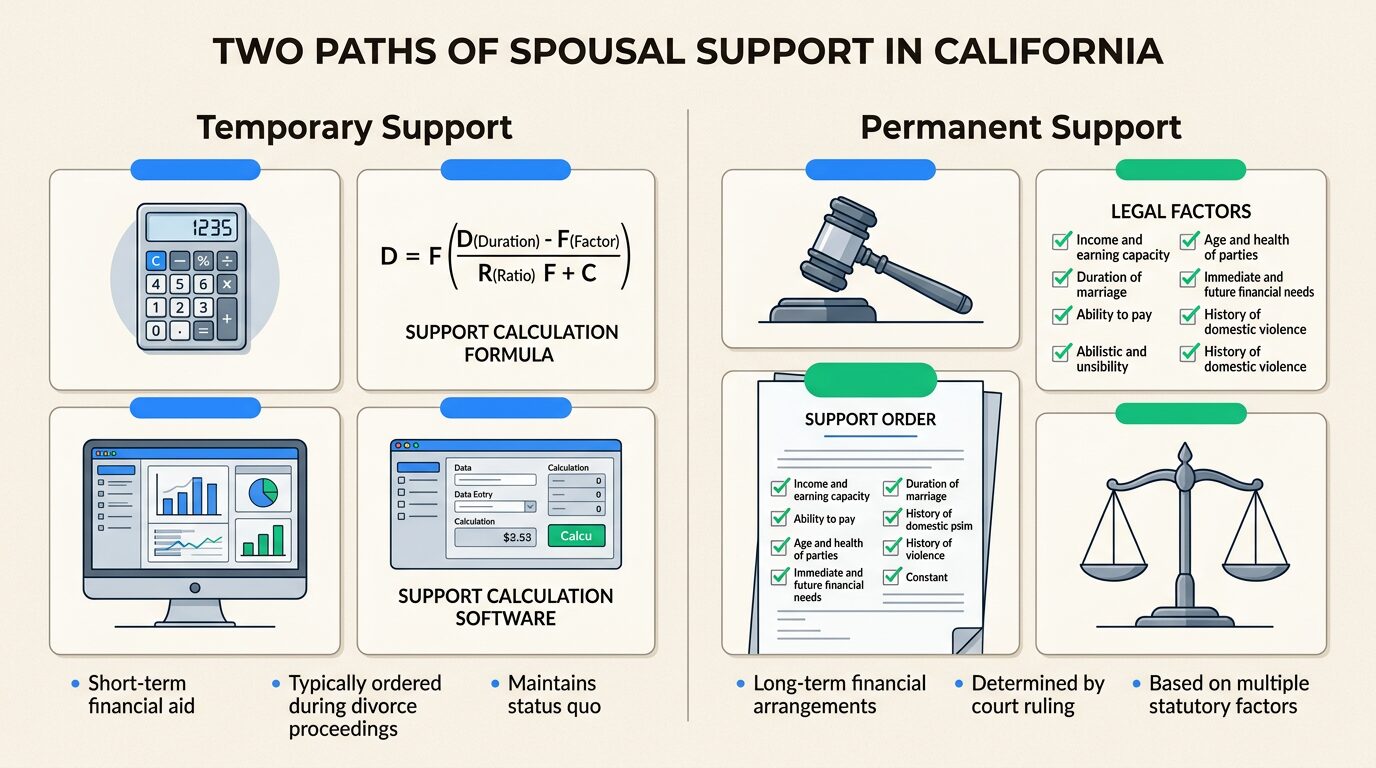
How is temporary Los Angeles spousal support calculated?
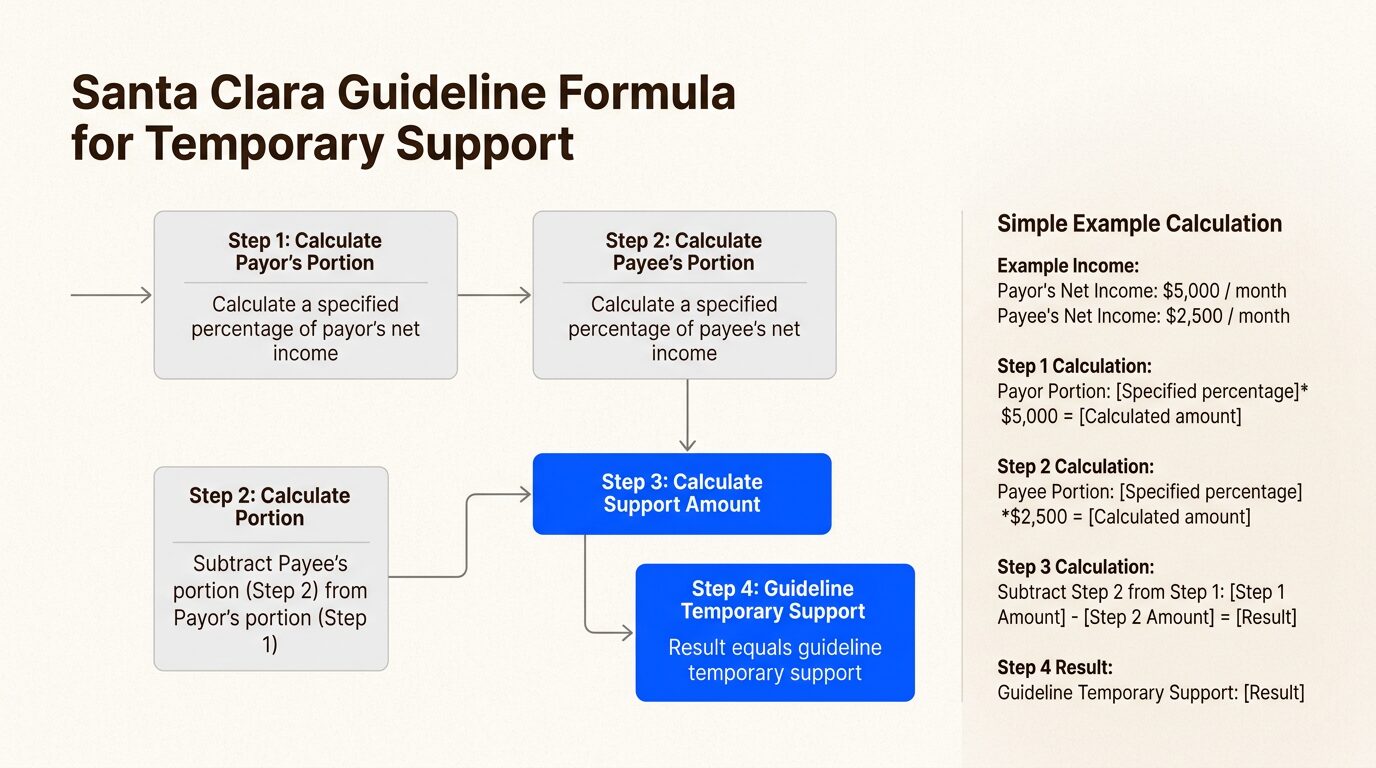
LA Superior Courts use guideline formulas, typically calculating temporary support as 40% of the paying spouse’s net monthly income minus 50% of the receiving spouse’s net monthly income, with child support calculated first if applicable.
The most common approach follows the Santa Clara Guideline formula. Here’s how it works in practice. If the paying spouse earns $20,000 net monthly, and the receiving spouse earns $5,000 net monthly, the calculation runs as follows: 40% of $20,000 equals $8,000. Half of $5,000 equals $2,500. Subtract $2,500 from $8,000, and the guideline temporary support equals $5,500 monthly.
Some California counties use the Alameda Guideline, which produces slightly different results. Los Angeles County generally follows the Santa Clara approach, though individual judges may vary. The specific formula matters less than understanding that the calculation is mechanical, not discretionary.
Courts rely on certified software programs to run these calculations. The Judicial Branch of California maintains a list of approved calculators including DissoMaster, Xspouse, Family Law Software, and Cal Support. These programs handle the mathematical complexity while incorporating current tax rates and deduction standards.
The income figures going into these calculations require careful attention. Gross income gets adjusted for taxes, mandatory retirement contributions, health insurance premiums, and certain other deductions. For W-2 employees, this is relatively straightforward. For business owners, executives with complex compensation, or investment-heavy households, determining the correct income figure becomes a significant analytical task.
2026 Low Income Adjustment (LIA): As of January 1, 2026, California’s minimum wage increased to $16.90 per hour. This establishes a Low Income Adjustment threshold of $2,929 per month in net disposable income. Payors earning less than this amount may qualify for reduced support obligations. This threshold updates periodically based on state minimum wage changes.
Important note on calculator certification: The California Child Support Guideline Calculator maintained by DCSS was decertified in 2025 because it had not been updated to reflect federal tax law changes from the July 2025 budget bill. For accurate calculations, use one of the Judicial Council certified programs instead.
| Factor | Temporary Support | Permanent Support |
|---|---|---|
| Calculation Method | Mathematical formula | Judicial discretion |
| Primary Authority | County guideline | Family Code §4320 |
| Software Used | DissoMaster, Xspouse, etc. | None (factor-based) |
| Modification | Adjustable during proceedings | Modifiable post-judgment |
| Duration | Until judgment entered | Per court order |
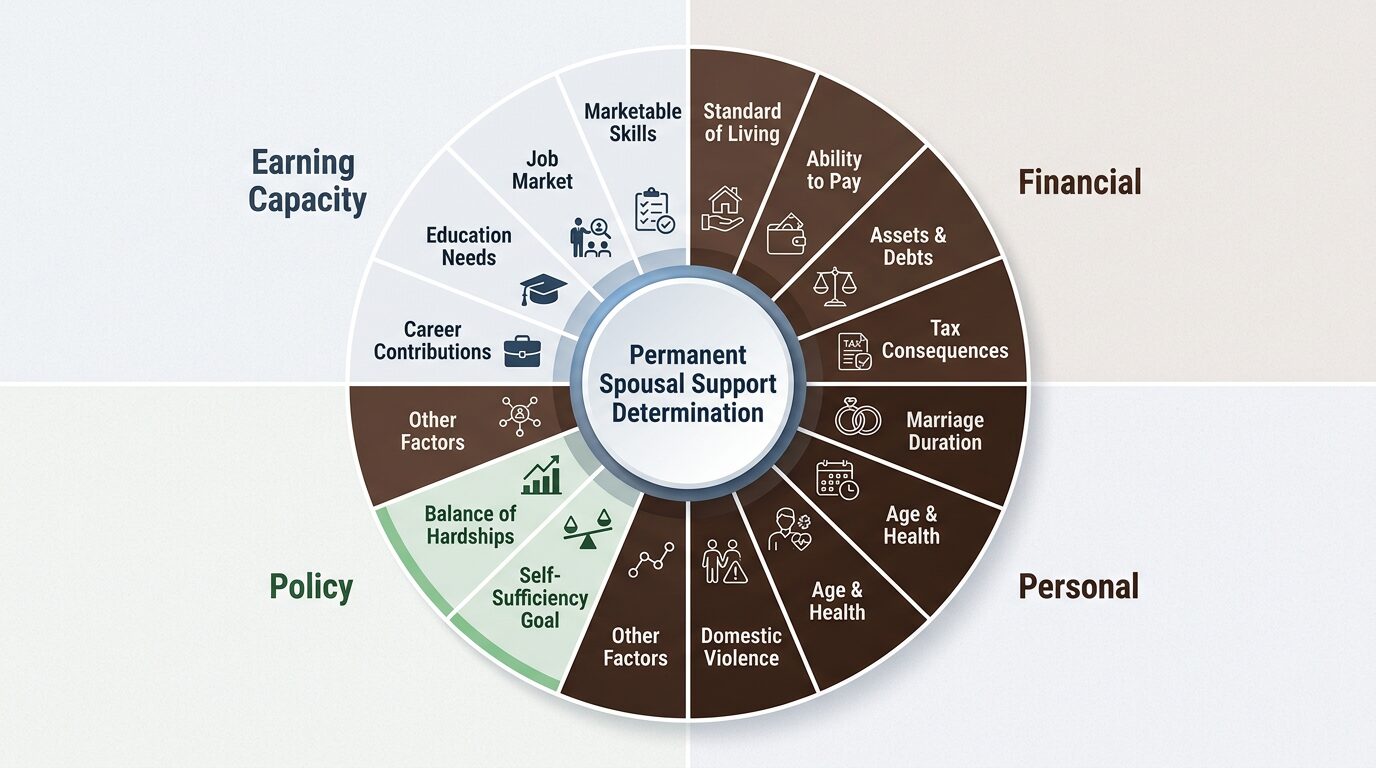
What are the 4320 factors for permanent Los Angeles alimony?
California Family Code §4320 requires courts to consider 14 factors including earning capacity, marital standard of living, marriage duration, age and health, contributions to the other spouse’s career, and the goal of self-sufficiency within a reasonable time.
The statute creates a comprehensive framework. Judges must examine each factor and explain how they influenced the final award. This structured discretion prevents arbitrary decisions while allowing flexibility for unique circumstances.
Earning capacity and employment factors
Courts look beyond current paychecks to assess each spouse’s ability to earn. This includes evaluating marketable skills, the local job market for those skills, and the time and expense required to acquire necessary education or training. If one spouse sacrificed career advancement to manage the household or raise children, that impairment to earning capacity weighs heavily in the analysis.
Contributions to the other spouse’s career also matter significantly. Did one spouse work to put the other through medical school? Did they relocate multiple times to support the other’s corporate advancement? These investments in the marital partnership receive recognition in the support calculation.
Financial and Lifestyle Factors in California Spousal Support
The marital standard of living serves as a critical benchmark when it comes to how courts calculate alimony. Courts aim to allow both spouses to maintain a lifestyle reasonably comparable to what they enjoyed during the marriage. For high net-worth households, this requires detailed examination of spending patterns, not just income figures.
The supporting spouse’s ability to pay extends beyond salary to include investment income, trust distributions, and other financial resources. Courts also examine the parties’ assets and debts, including separate property that remains with each spouse after the divorce.
Tax consequences receive explicit consideration. Since 2019, federal tax law no longer allows spousal support deductions for payors or requires recipients to report support as income. However, California state tax law still permits the deduction for payors and requires recipients to report support as income. This federal-state disconnect complicates settlement negotiations.
Personal Circumstances Impact on Los Angeles Alimony Calculations
Marriage duration heavily influences both amount and length of support. The 10-year threshold separates short-term from long-term marriages, triggering different presumptions about appropriate support duration.
Age and health affect both earning capacity and need. A 58-year-old spouse who has been out of the workforce for 25 years faces different challenges than a 35-year-old with recent employment history. Health conditions that limit employment or increase expenses receive appropriate weight.
Domestic violence history can affect support awards in either direction. California Family Code §§ 4324, 4324.5, and 4325 create specific rules for cases involving documented abuse. A supported spouse’s history of violence against the supporting spouse may reduce or eliminate support. Conversely, a supporting spouse’s abuse may increase support obligations.
The self-sufficiency goal
California policy favors eventual self-sufficiency. Courts must consider “the goal that the supported party shall be self-supporting within a reasonable period of time.” For marriages under 10 years, “reasonable period” generally means half the marriage length. For longer marriages, this presumption does not apply.
Judges may order vocational evaluations to assess a spouse’s realistic earning capacity. They may also build step-down provisions into support orders, gradually reducing payments as the supported spouse is expected to increase their income.
County Specific Considerations in Los Angeles Alimony
Filing for spousal support in LA Superior Court requires navigating specific local procedures. Motions for temporary support typically get heard relatively quickly, but the court’s calendar affects timing. Working with a Los Angeles spousal support attorney who understands local judicial tendencies helps set realistic expectations.
High net-worth cases often require collaboration with forensic accountants to properly characterize income. Los Angeles has a robust community of financial experts experienced in complex divorce matters. Choosing the right professional team matters as much as choosing the right attorney.
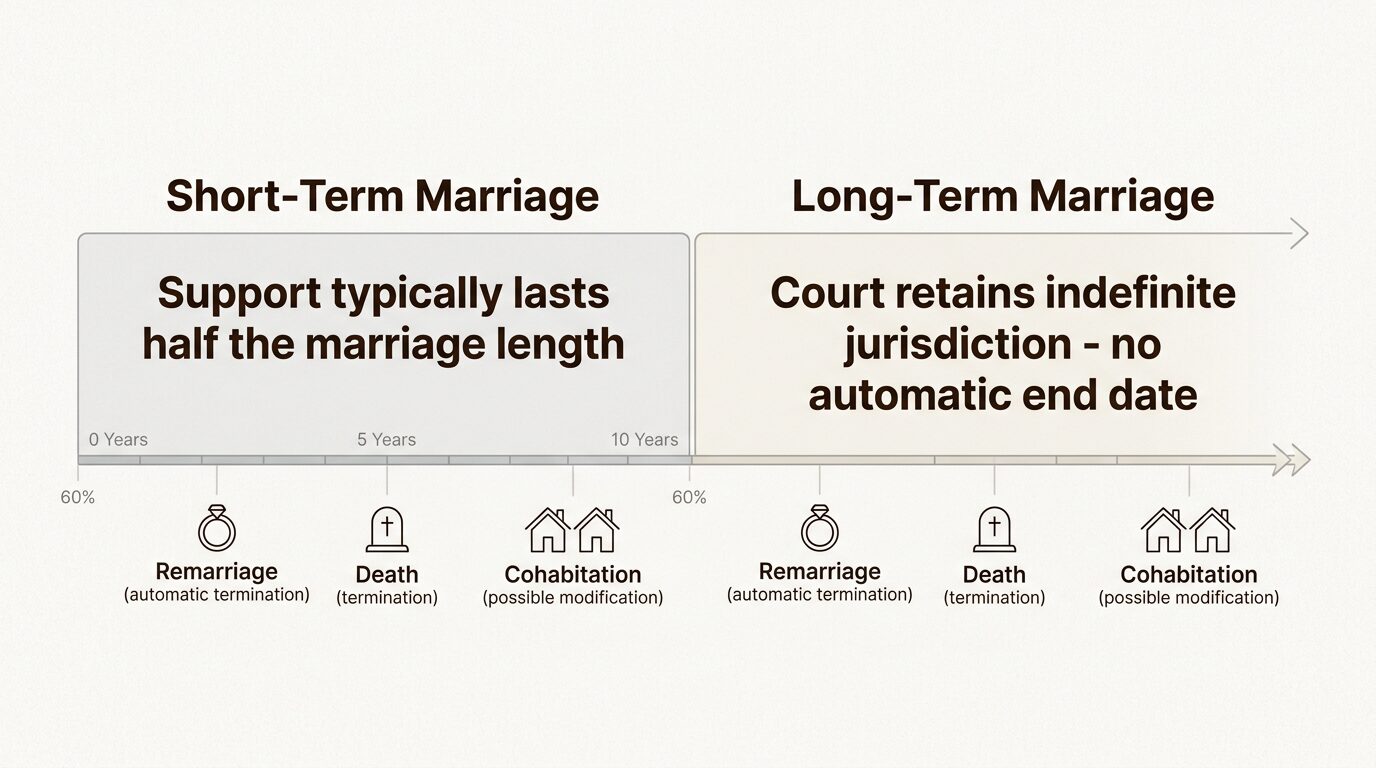
How Courts Calculate Alimony Based on the Length of the Marriage: The 10-Year Rule
For marriages under 10 years, support typically lasts half the marriage length. For marriages of 10 years or more (“long-duration”), courts retain indefinite jurisdiction and may order support without a fixed end date.
The 10-year rule generates significant confusion. Many people believe that crossing the 10-year threshold automatically triggers lifetime alimony. This is not true. What actually happens is more nuanced and, in some ways, more consequential.
Short-term marriages (under 10 years)
For marriages lasting less than a decade, California law presumes that spousal support should continue for approximately half the marriage duration. An eight-year marriage would typically generate support for four years. A six-year marriage, three years.
This presumption is rebuttable. Courts can order shorter or longer support periods based on the specific circumstances. A spouse who requires significant retraining to reenter the workforce might receive support beyond the half-duration mark. Conversely, a spouse who is already self-supporting might receive less.
Long-term marriages (10 years or more)
Marriages lasting 10 years or more qualify as “of long duration” under California Family Code §4336. This classification removes the half-duration presumption entirely. More significantly, it gives the court indefinite jurisdiction over spousal support.
Indefinite jurisdiction means the court retains authority to modify, extend, or terminate support orders long into the future. Even if the original judgment set a termination date, the court can revisit the issue if circumstances change. This creates ongoing legal exposure for the supporting spouse.
However, indefinite jurisdiction does not mean indefinite support. Courts still expect supported spouses to become self-sufficient when reasonably possible. The difference is that judges have flexibility to extend support if legitimate need persists, without being constrained by the half-marriage formula.
California Spousal Support Termination Events
Regardless of marriage length, spousal support automatically terminates upon the supported spouse’s remarriage unless the parties agreed otherwise in writing. Support also terminates upon either spouse’s death. The obligation does not extend to the deceased spouse’s estate.
Cohabitation by the supported spouse can also affect support. While not an automatic termination event, cohabitation with a new partner creates a rebuttable presumption of reduced need. The supporting spouse can file for modification based on changed circumstances.
What special considerations apply to high net-worth spousal support cases?
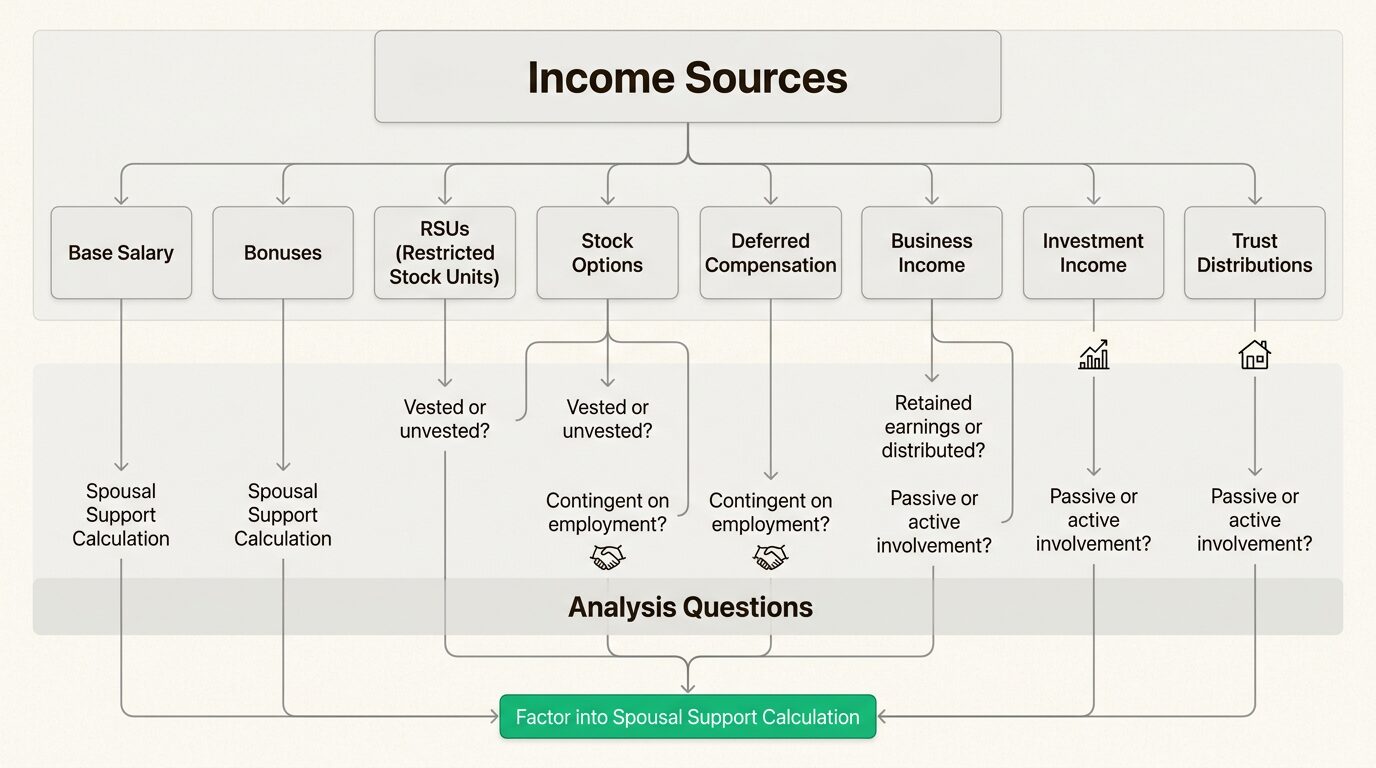
High net-worth cases require analysis of executive compensation, RSUs, stock options, deferred income, business valuations, and complex asset structures that standard guideline calculations don’t adequately address.
Standard temporary support calculations struggle to capture the full financial picture in high net-worth households. The software programs work well for straightforward W-2 income. They handle executive compensation, business ownership, and investment portfolios less effectively.
Executive compensation complexities
Base salary often represents only a fraction of total executive compensation. Bonuses, restricted stock units (RSUs), stock options, deferred compensation, and performance-based incentives require careful analysis. Some of these forms of compensation are more certain than others. Some vest immediately; others stretch over years.
Courts must decide which compensation components constitute income available for support. Vested RSUs may clearly count. Unvested options that require continued employment might not. The analysis requires understanding both the legal framework and the specific compensation structures at play.
Self-employment and business interests
Business owners present particular challenges. The business might retain earnings rather than distributing them to the owner. Is retained income available for support? The answer depends on the business’s legitimate needs, the owner’s control over distributions, and historical patterns.
Business valuation may also affect support. If one spouse receives a business worth millions in the property division, does that reduce their need for ongoing support? Or does the business generate income that should be considered for support purposes? These questions require sophisticated financial analysis.
Tax implications
The 2019 federal tax law changes significantly affected spousal support negotiations. For divorces finalized after December 31, 2018, payors can no longer deduct support payments, and recipients need not report support as income. This removed a significant tax planning tool from the negotiating table.
California, however, maintained its prior treatment. Payors can still deduct support on state returns; recipients must still report it as income. This federal-state disconnect complicates settlement negotiations and requires careful tax planning.
Marital standard of living documentation
High net-worth households often have complex spending patterns. Multiple residences, extensive travel, luxury goods, household staff, and significant charitable contributions all factor into the marital standard of living. Documenting this lifestyle requires detailed financial records and often expert testimony.
Courts aim to allow both spouses to maintain a lifestyle reasonably comparable to the marital standard. For wealthy households, this might mean support awards that seem extravagant by ordinary standards. The goal is fairness between the spouses, not austerity for the supported spouse.
Working with a high-asset divorce attorney who understands these complexities makes a significant difference in outcomes. The analysis requires both legal expertise and financial sophistication.
When can spousal support be modified in Los Angeles?
Spousal support can be modified when there is a significant change in circumstances, such as income changes, job loss, retirement, remarriage, cohabitation, or health changes affecting earning capacity.
California courts retain jurisdiction to modify spousal support orders when material changes occur. The supporting spouse bears the burden of proving changed circumstances warranting modification. The supported spouse can also seek increases if need grows or the supporting spouse’s income rises significantly.
Common modification triggers
Income changes represent the most frequent basis for modification. Job loss, career changes, or business downturns may justify reducing support. Conversely, promotions, new employment, or business success might support an increase.
Retirement often triggers modification requests. When a supporting spouse retires in good faith at a reasonable age, their reduced income may warrant support reduction. The analysis examines whether retirement was voluntary or forced, reasonable given age and health, and anticipated during the original support order.
Remarriage automatically terminates support unless the parties agreed otherwise. Cohabitation creates a rebuttable presumption of reduced need, though the supported spouse can present evidence that their financial situation hasn’t actually improved.
Health changes affecting either spouse’s earning capacity or financial need can support modification. Disability, chronic illness, or recovery from previously limiting conditions all potentially affect support obligations.
The modification process
To modify support, the requesting spouse files a motion with the LA Superior Court. The motion must demonstrate the material change in circumstances and explain why modification serves equity. Both spouses typically submit current income documentation and expense declarations.
The court may order a hearing where both sides present evidence. Alternatively, if the change is clear and undisputed, the court might rule based on submitted paperwork. The process generally moves faster than initial divorce proceedings but still requires patience.
Gavron warnings
California courts sometimes issue “Gavron warnings” to supported spouses, advising them that they are expected to become self-supporting within a reasonable time. This warning puts the supported spouse on notice that failure to make good-faith efforts toward self-sufficiency may affect future support. The warning is not an order to become self-sufficient, but it frames the court’s expectations.
For those seeking or opposing modification, working with an experienced alimony modification attorney helps present the strongest possible case.
Getting clarity on your spousal support case
While online calculators provide estimates, accurate spousal support determination requires analysis of your specific financial situation, application of relevant factors, and strategic presentation of evidence to the court.
Online calculators have value. They give you a rough sense of what temporary support might look like based on income inputs. But they cannot capture the nuances that drive actual outcomes. They don’t evaluate the 4320 factors that determine permanent support. They don’t address high net-worth complexities or local judicial tendencies.
The difference between a rough estimate and an accurate projection often amounts to thousands of dollars monthly. For a support order that might last years or even decades, that difference compounds into serious money.
Strategic considerations
Timing matters. When should you seek temporary orders? How should you present your financial situation? What evidence best supports your position on the 4320 factors? These strategic questions require experience with how LA courts actually operate.
Settlement negotiations often produce better outcomes than litigation. A negotiated agreement gives both spouses certainty and control. It avoids the expense and stress of trial. But effective negotiation requires understanding what a court would likely order if the case went to trial. That baseline knowledge drives realistic settlement discussions.
The Marsh Firm approach
At The Marsh Firm, we combine detailed financial analysis with strategic negotiation to achieve fair spousal support outcomes. We work with forensic accountants, vocational experts, and other specialists when complex issues require specialized expertise. Our focus is protecting your financial future while minimizing unnecessary conflict.
We understand that spousal support is rarely just about money. It touches on questions of fairness, contribution, and what each spouse deserves after the marriage ends. We help clients navigate these emotional dimensions while keeping sight of practical financial goals.
If you are facing spousal support questions in a Los Angeles divorce, we invite you to request a private consultation. We will review your situation, explain your options, and help you develop a strategy tailored to your specific circumstances.
Frequently Asked Questions
How does the court decide how much alimony to award in California?
Courts consider income, earning capacity, and 14 statutory factors under Family Code §4320. For temporary support during divorce proceedings, they use guideline formulas. For permanent support after judgment, judges exercise discretion based on the statutory factors.
Is there a calculator for permanent spousal support in California?
No. Permanent support is factor-based, not formula-based. Only temporary support uses calculators like DissoMaster or Xspouse. Permanent support requires judicial analysis of the 4320 factors specific to each case.
What is the 10-year rule for alimony in California?
There is no automatic lifetime support after 10 years. However, marriages lasting 10 years or more qualify as ‘of long duration,’ which gives courts indefinite jurisdiction over spousal support. This means the court can modify, extend, or terminate support in the future based on changed circumstances.
Can I modify my spousal support order in Los Angeles?
Yes, if there has been a significant change in circumstances such as income changes, job loss, retirement, remarriage, cohabitation, or health changes affecting earning capacity. You must file a motion with the LA Superior Court demonstrating the material change.
How long does temporary spousal support last in California?
Temporary support continues until the divorce is finalized and the court enters a judgment for permanent support (if any). There is no fixed duration; it depends on how long the divorce proceedings take.
Does remarriage affect spousal support in California?
Yes. Spousal support automatically terminates when the supported spouse remarries, unless the parties had a written agreement stating otherwise. The obligation also terminates upon either spouse’s death.
How do I calculate temporary spousal support in Los Angeles?
LA courts typically use the Santa Clara Guideline: 40% of the paying spouse’s net monthly income minus 50% of the receiving spouse’s net monthly income. Courts use certified software programs like DissoMaster to run these calculations. Child support gets calculated first if applicable.