

How to Ensure Your Prenup Holds Up in California | A Legal Guide to Los Angeles Prenups in 2026
Yes. Prenuptial agreements are enforceable in California when they meet the statutory requirements under the Uniform Premarital Agreement Act (UPAA), codified in California Family Code §§ 1610-1617. For agreements executed on or after January 1, 2020, California imposes strict procedural safeguards including a mandatory 7-day waiting period between presentation of the final agreement and signing, full financial disclosure, and notarization. Courts may refuse to enforce prenups that were signed under duress, contain unconscionable terms, or fail to meet these procedural requirements. The agreement must be in writing, signed voluntarily by both parties, and executed with sufficient time for review and independent legal counsel.
What makes a prenuptial agreement legally binding in California?
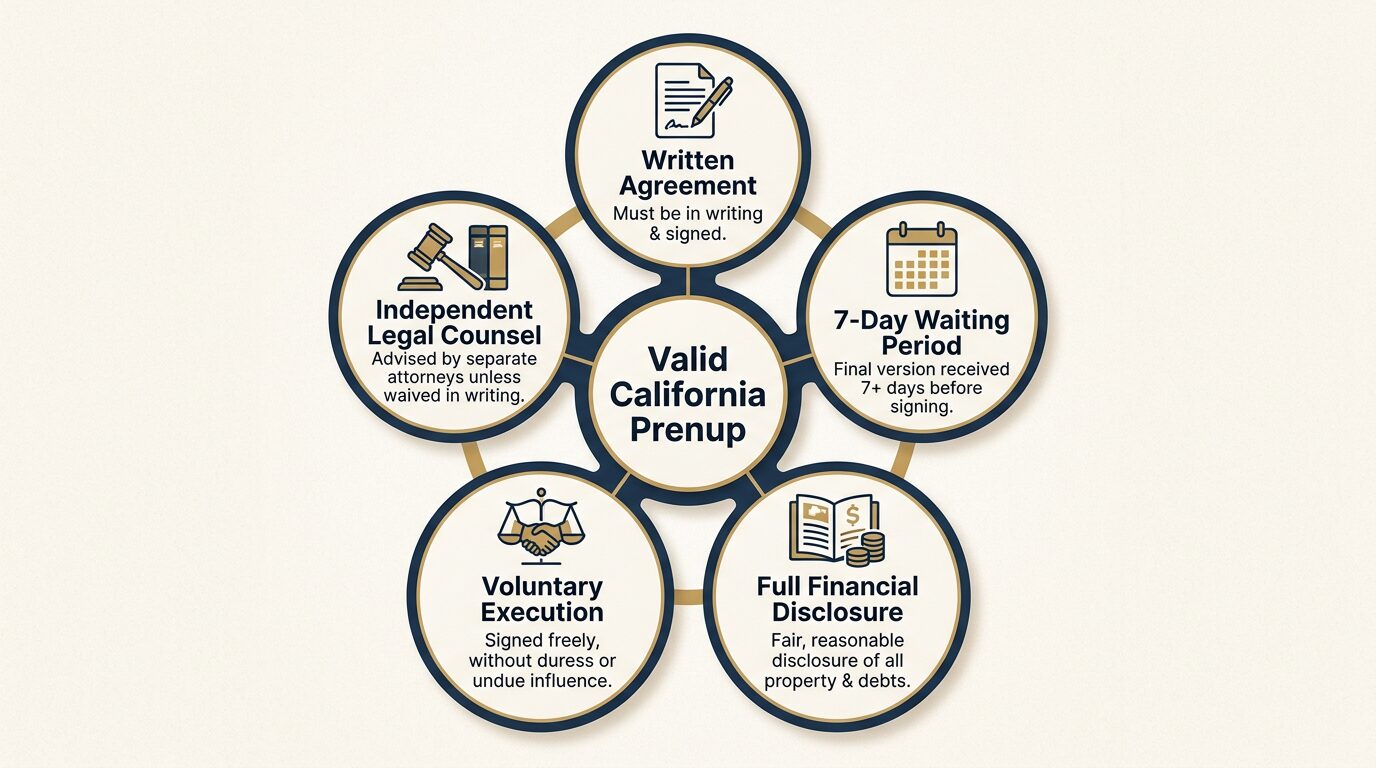
A prenuptial agreement in California is legally binding only when it satisfies the specific requirements outlined in California Family Code § 1615. The statute creates a framework designed to ensure both parties enter the agreement voluntarily and with full knowledge of what they’re signing.
The foundational requirements include:
- Written agreement: Oral prenuptial agreements aren’t enforceable in California. The agreement must be in writing and signed by both parties.
- Voluntary execution: Neither party can be under duress, fraud, or undue influence. Both must have the mental capacity to understand the agreement.
- Full financial disclosure: Each party must provide a fair, reasonable, and full disclosure of their property and financial obligations. Concealing assets can invalidate the entire agreement.
- Notarization: While not explicitly required by statute, notarization provides evidence that signatures are authentic and helps establish that the agreement was executed properly.
- Independent legal counsel: Required specifically for spousal support waivers under Family Code § 1612(c), but strongly recommended for all prenups.
In our practice, we’ve seen agreements challenged years after execution because one party claimed they didn’t understand what they were signing. The statutory requirements exist to prevent exactly this scenario.
The 7-day rule: California’s critical waiting period
The 7-day rule represents one of the most significant protections for parties signing prenuptial agreements in California. Under Family Code § 1615(c)(2)(B), for agreements executed on or after January 1, 2020, the party against whom enforcement is sought must have at least seven calendar days between when they were first presented with the final agreement and when they signed it.
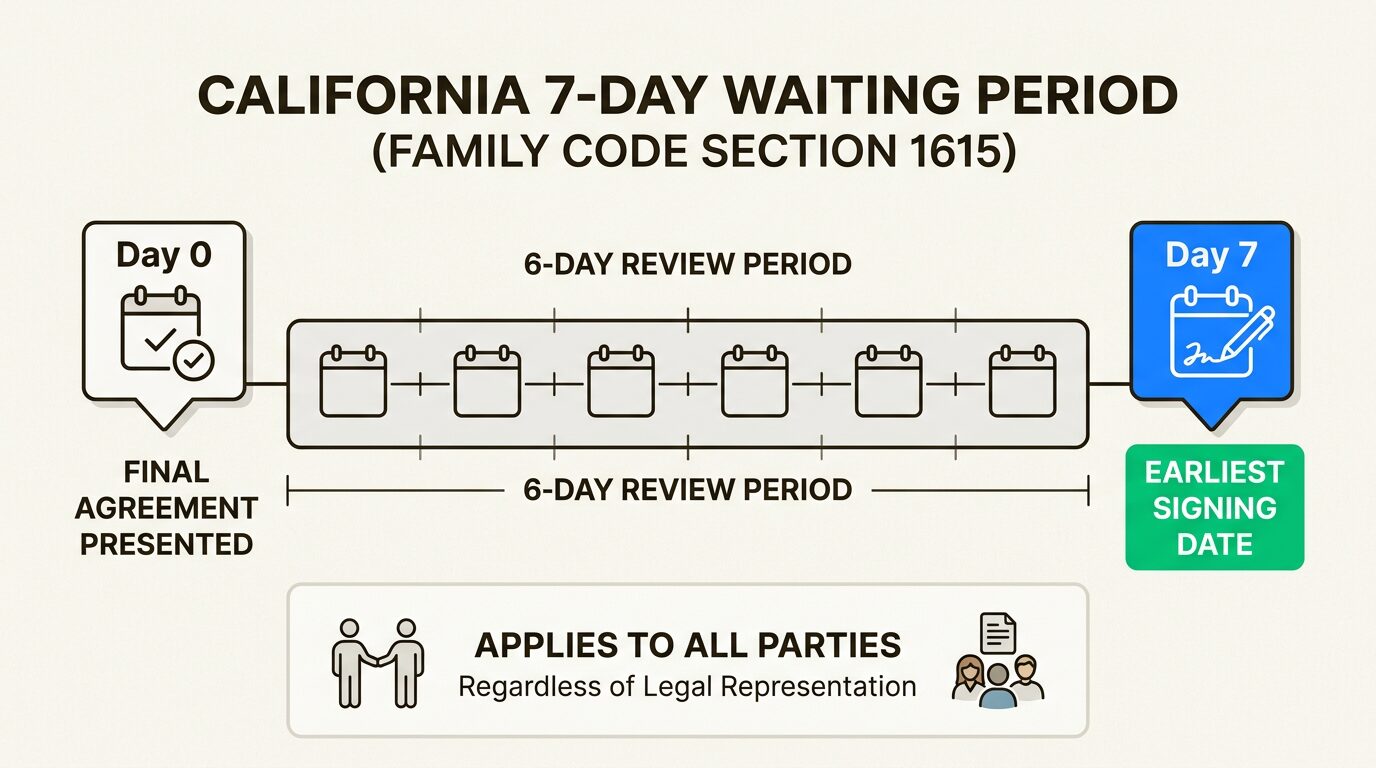
This requirement applies regardless of whether the party is represented by legal counsel. Even if both parties are eager to sign and see no reason to wait, the 7-day period is mandatory and non-waivable.
The 2020 amendment (AB 1380) made this requirement stricter than the previous version of the law. For agreements executed between January 1, 2002 and January 1, 2020, the 7-day period only applied if the party was seeking independent legal counsel. The current law removed that condition, recognizing that parties need time to review and consider the agreement regardless of their representation status.
How do California courts evaluate prenup enforceability during divorce?
When a divorce case involves a prenuptial agreement, California judges examine both procedural compliance and substantive fairness. The court’s role isn’t simply to rubber-stamp an agreement because it exists, but to ensure it meets the statutory standards for enforceability.
Judges evaluate several factors:
- Whether the procedural requirements of § 1615 were followed, including the 7-day waiting period and disclosure obligations
- Whether the terms were fair and reasonable at the time of execution
- Whether circumstances have changed significantly since the agreement was signed
- Whether enforcement would leave one spouse in a position of financial destitution
The burden of proving a prenup is unenforceable typically falls on the party challenging it. However, if that party can demonstrate involuntary execution or unconscionability combined with inadequate disclosure, the court may set aside the agreement or specific provisions within it.
When will a judge refuse to enforce a prenup?
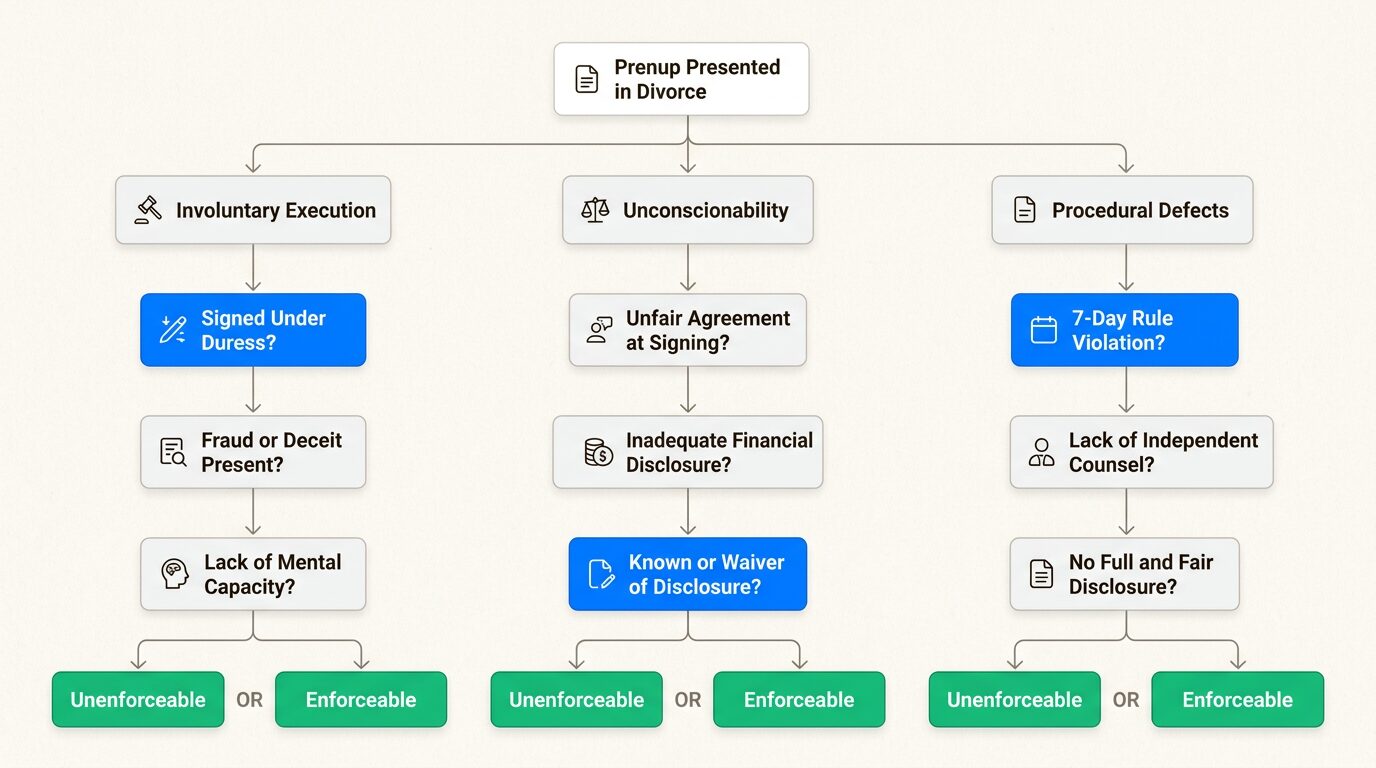
California courts may refuse to enforce a prenuptial agreement on three primary grounds:
1. Involuntary execution
If one party can prove they signed under duress, fraud, or undue influence, the agreement may be invalidated. Common scenarios include presenting the prenup days before the wedding when family has already arrived from out of town, or threatening to call off the wedding unless the agreement is signed immediately.
2. Unconscionability
An agreement is unconscionable if it’s so one-sided or unjust that it shocks the conscience. However, under § 1615(a)(2), unconscionability alone isn’t enough to invalidate a prenup. It must be combined with a failure to provide adequate financial disclosure or a waiver of disclosure rights.
3. Lack of full financial disclosure
Concealing assets, understating income, or failing to disclose debts can undermine the entire agreement. If one party discovers after signing that the other failed to disclose significant assets (such as cryptocurrency holdings, foreign accounts, or business interests), the court may find the agreement unenforceable.
Los Angeles County family court procedures for prenup challenges
When filing for divorce in Los Angeles County, prenuptial agreement validity is typically determined early in the proceedings, often through motion practice before the Stanley Mosk Courthouse or other LA County Superior Court family law divisions.
In our experience handling cases at the downtown Los Angeles courthouse, judges prefer to resolve prenup validity questions promptly to streamline the remainder of the divorce process. This often involves expedited discovery regarding financial disclosure and may include depositions of the attorneys who drafted the original agreement.
What can and cannot be included in a California prenup?
California law allows parties to contract regarding most financial matters while drawing clear lines around issues involving children and public policy.
Permissible provisions include:
- Property rights and obligations in any property, wherever acquired or located
- Rights to buy, sell, transfer, or manage property
- Disposition of property upon separation, divorce, or death
- Estate planning arrangements to carry out the agreement
- Life insurance policy ownership and death benefits
- Spousal support provisions (with independent counsel requirement for waivers)
Prohibited provisions include:
- Child custody arrangements (courts retain jurisdiction to determine custody based on the child’s best interests at the time of divorce)
- Child support limitations (child support is the right of the child, not the parents, and cannot be contracted away)
- Lifestyle clauses penalizing infidelity (California is a no-fault divorce state, and such clauses may violate public policy)
- Requirements to commit illegal acts
- Terms that are unconscionable or violate public policy
Protecting business interests and complex assets
For high-net-worth individuals, prenuptial agreements serve a critical function in protecting business interests and complex asset structures. Without a prenup, a business started before marriage or appreciated during marriage may become subject to community property division.
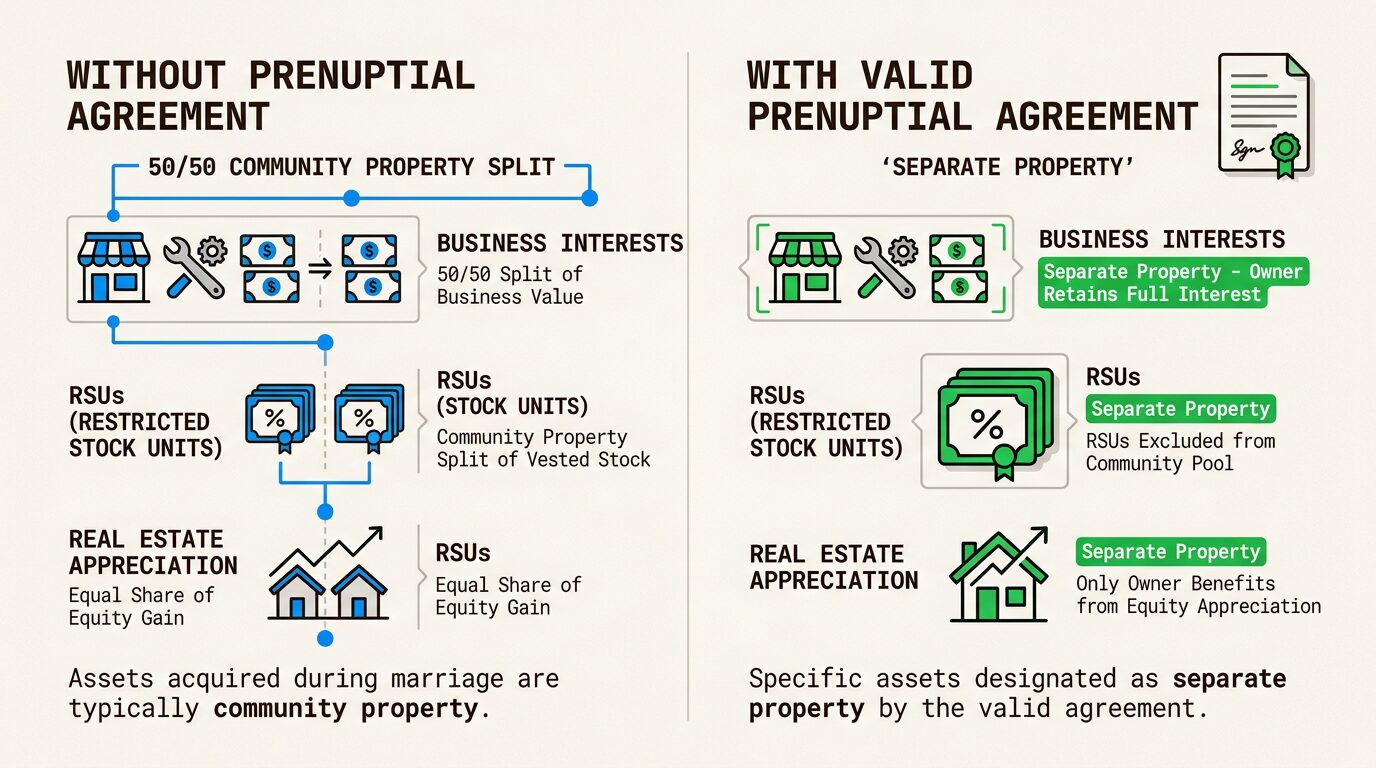
A properly drafted prenup can:
- Keep businesses as separate property, excluding them from community property division
- Define how future appreciation in business value will be treated
- Avoid costly business valuations and disruption to operations during divorce
- Protect executive compensation including RSUs, stock options, and deferred compensation
- Address intellectual property rights and future earnings
In our practice representing entrepreneurs and executives in Los Angeles, we’ve found that addressing these issues proactively prevents significant conflict later. The cost of a well-drafted prenup is minimal compared to the expense of litigating business valuation disputes during divorce.
Navigating the Los Angeles County legal system with a prenup
When a prenuptial agreement is at issue in a Los Angeles County divorce, the process typically begins with a motion to determine validity. This motion is usually heard early in the case, often within the first few months of filing.
The timeline for prenup-related motions in LA County generally follows this pattern:
- Filing and service: The divorce petition is filed, with the prenup attached as an exhibit
- Responsive pleadings: The responding party may challenge the prenup’s validity in their response
- Discovery: Limited discovery on financial disclosure and execution circumstances
- Motion hearing: A judge determines whether the prenup is enforceable as a matter of law
Working with qualified forensic accountants is often essential in prenup challenges, particularly when questions arise about whether financial disclosure was complete. Los Angeles has a robust network of forensic accounting professionals experienced in high-asset divorce matters.
Common mistakes when executing prenups in California
Despite the clear statutory requirements, we regularly see the same mistakes undermine otherwise sound agreements:
Waiting too long: Presenting a prenup days before the wedding creates pressure that can support a claim of duress. We recommend beginning the process 3-6 months before the wedding date.
Inadequate financial disclosure: Failing to disclose cryptocurrency holdings, foreign assets, or contingent business interests can invalidate the agreement. Full disclosure means complete transparency.
Using template agreements: Online templates rarely account for California’s specific requirements, particularly the 7-day rule and spousal support counsel requirements. They also fail to address complex asset structures common among high-net-worth clients.
Failing to update: Major life changes (birth of children, significant asset acquisitions, business sales) may warrant revisiting the prenup through a postnuptial agreement or amendment.
How The Marsh Firm approaches prenuptial agreements
This complex process is exactly how we approach cases at The Marsh Firm to ensure no detail is overlooked. We believe prenuptial agreements should be drafted through strategic negotiation rather than adversarial confrontation. Our focus is on creating agreements that protect our clients’ interests while respecting the relationship they’re building.
Our protocols include comprehensive financial disclosure processes, experienced coordination with forensic accountants for complex asset valuation, and careful attention to the procedural requirements that California courts scrutinize. We’ve guided entrepreneurs, executives, and professionals through prenup negotiations that address RSUs, closely held business interests, and multi-jurisdictional asset holdings.
Most importantly, we approach these conversations with a family-first mindset. A prenup should provide clarity and security, not create resentment before the marriage begins.
Next steps: protecting your financial future
If you’re considering a prenuptial agreement, the most important step is to begin early. The 3-6 month timeline isn’t arbitrary; it ensures adequate time for disclosure, negotiation, and the mandatory 7-day review period.
Both parties should have independent legal counsel. This isn’t just a statutory requirement for certain provisions; it’s protection for both parties and significantly strengthens the agreement’s enforceability.
At The Marsh Firm, we bring deep experience with high-net-worth prenuptial agreements and the complex asset structures common among Los Angeles professionals. We understand that these conversations require sensitivity, precision, and strategic thinking.
If you’re facing questions about a prenuptial agreement, whether drafting one or determining its validity during divorce, you can request a private consultation today to get started with expert legal guidance tailored to your situation.
Frequently Asked Questions
What is the 7-day rule for prenups in California?
The 7-day rule requires that the final prenuptial agreement be presented to each party at least seven calendar days before signing. This applies to all agreements executed on or after January 1, 2020, regardless of whether the party has legal counsel. The waiting period is mandatory and cannot be waived.
Can a prenup be invalidated after 10 years of marriage in California?
Yes, a prenup can be challenged at any time, including after 10 years of marriage. However, the passage of time alone does not invalidate an agreement. The challenging party must prove grounds such as involuntary execution, unconscionability combined with inadequate disclosure, or failure to meet procedural requirements.
Is California a 50/50 divorce state even with a prenup?
Without a prenup, California’s community property laws generally require a 50/50 division of assets acquired during marriage. A valid prenuptial agreement can override this default and establish different terms for property division. However, the prenup must meet all statutory requirements to be enforceable.
Do both parties need a lawyer for a prenup in California?
California law requires independent legal counsel for spousal support waivers to be enforceable. While not strictly required for other provisions, having separate attorneys for both parties significantly strengthens the agreement’s defensibility and demonstrates that both parties understood their rights.
What happens if a prenup is not notarized in California?
While notarization is not explicitly required by statute, an unnotarized prenup may face challenges regarding the authenticity of signatures and whether the agreement was properly executed. Notarization provides important evidence that the signing was voluntary and occurred as represented.
Can a prenup protect my business in a California divorce?
Yes, a properly drafted prenuptial agreement can protect business interests by keeping them as separate property, defining how appreciation will be treated, and avoiding costly business valuations during divorce. This is one of the most common reasons high-net-worth individuals seek prenups.
What makes a prenup unconscionable in California?
A prenup may be deemed unconscionable if it is so one-sided or unjust that it shocks the conscience. However, under California Family Code § 1615, unconscionability alone is not enough to invalidate an agreement. It must be combined with a failure to provide adequate financial disclosure or a knowing waiver of disclosure rights.