

Can You Get a Prenup After You’re Already Married in California? | Postnuptial Agreements
The short answer is no. Once you’re married, you cannot create a prenuptial agreement. But that doesn’t mean you’ve lost your opportunity to protect your assets or clarify financial expectations. California law allows married couples to enter into a postnuptial agreement, which serves essentially the same function as a prenup, just with different legal requirements and heightened court scrutiny.
Postnuptial agreements are particularly relevant for high-net-worth individuals who experience significant financial changes during marriage: starting a business, receiving an inheritance, or accumulating substantial assets that weren’t anticipated before the wedding. In our practice at The Marsh Firm, we regularly work with Los Angeles professionals, entrepreneurs, and public figures who need these protections after they’ve already said “I do.”
Here’s what you need to understand about postnuptial agreements in California, including why they face stricter scrutiny than prenups and how to ensure yours will hold up if challenged.
How Do Postnuptial Agreements Differ From Prenuptial Agreements?
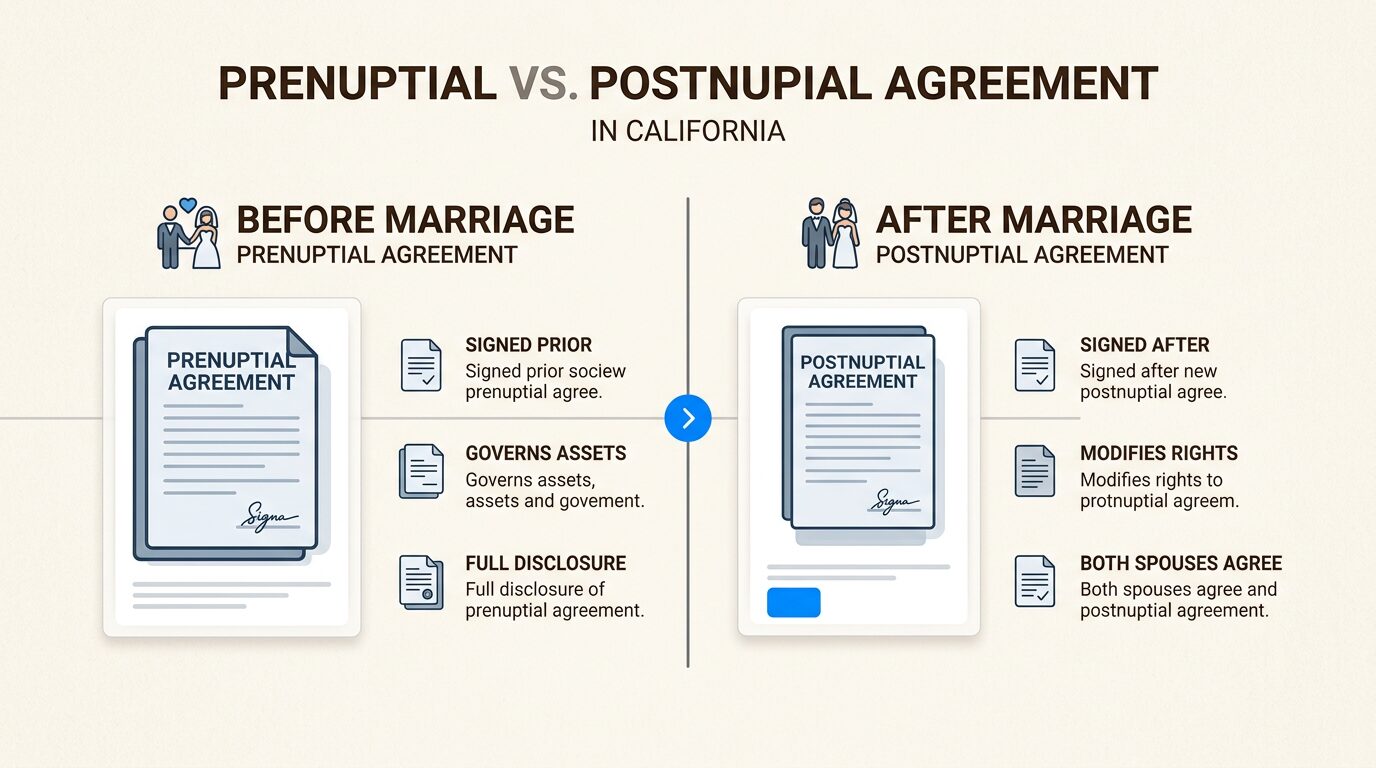
The fundamental difference is timing, but that timing difference triggers significantly different legal standards. Let’s break down the key distinctions:
Timing and Legal Framework
Prenuptial agreements are signed before marriage and governed by California’s Uniform Premarital Agreement Act (Family Code §§ 1600-1617). These statutes provide a clear framework for what prenups can cover, when they become effective, and when they may be challenged.
Postnuptial agreements lack this standalone statutory framework. Instead, courts evaluate them using general contract principles plus the heightened standards that apply because the parties are already spouses. This means judges have more discretion, and outcomes can be less predictable.
Court Scrutiny and Enforcement
Courts scrutinize postnups more heavily than prenups for several reasons:
- Presumption of undue influence: When one spouse presents an agreement to the other, courts presume the possibility of pressure or manipulation. The spouse seeking enforcement must overcome this presumption.
- Fiduciary duty violation: If the agreement appears to take unfair advantage of one spouse, it may violate the fiduciary duty owed under Family Code § 721.
- Power imbalances: Existing dynamics in the marriage, such as one spouse controlling finances or earning significantly more, can make agreements appear coerced.
The 7-Day Rule
California requires a 7-day waiting period between presenting a final prenuptial agreement and signing it. This gives both parties time to review and seek independent counsel.
Postnuptial agreements have no equivalent statutory waiting period. But that doesn’t mean speed is advisable. A postnup presented during a marital crisis, or handed to a spouse without meaningful time to review, will raise exactly the red flags that make courts skeptical. The underlying principle, adequate time and full information to make a real decision, absolutely applies.
Comparison: Prenup vs. Postnup
| Aspect | Prenuptial Agreement | Postnuptial Agreement |
|---|---|---|
| Timing | Signed before marriage | Signed after marriage |
| Legal Standard | Family Code §§ 1600-1617 | Contract law + fiduciary duty |
| Court Scrutiny | Standard contract review | Heightened scrutiny |
| Waiting Period | 7 days required by statute | No statutory requirement |
| Spousal Support Waivers | Allowed with independent counsel | Examined closely for fairness |
| Burden of Proof | Standard contract enforcement | Spouse seeking enforcement bears burden |
Why Do Married Couples Create Postnuptial Agreements?
Life rarely follows the path we anticipate at the altar. Financial circumstances change, businesses grow, and priorities shift. Here are the most common scenarios we see in our Los Angeles practice:
Business Ownership Changes
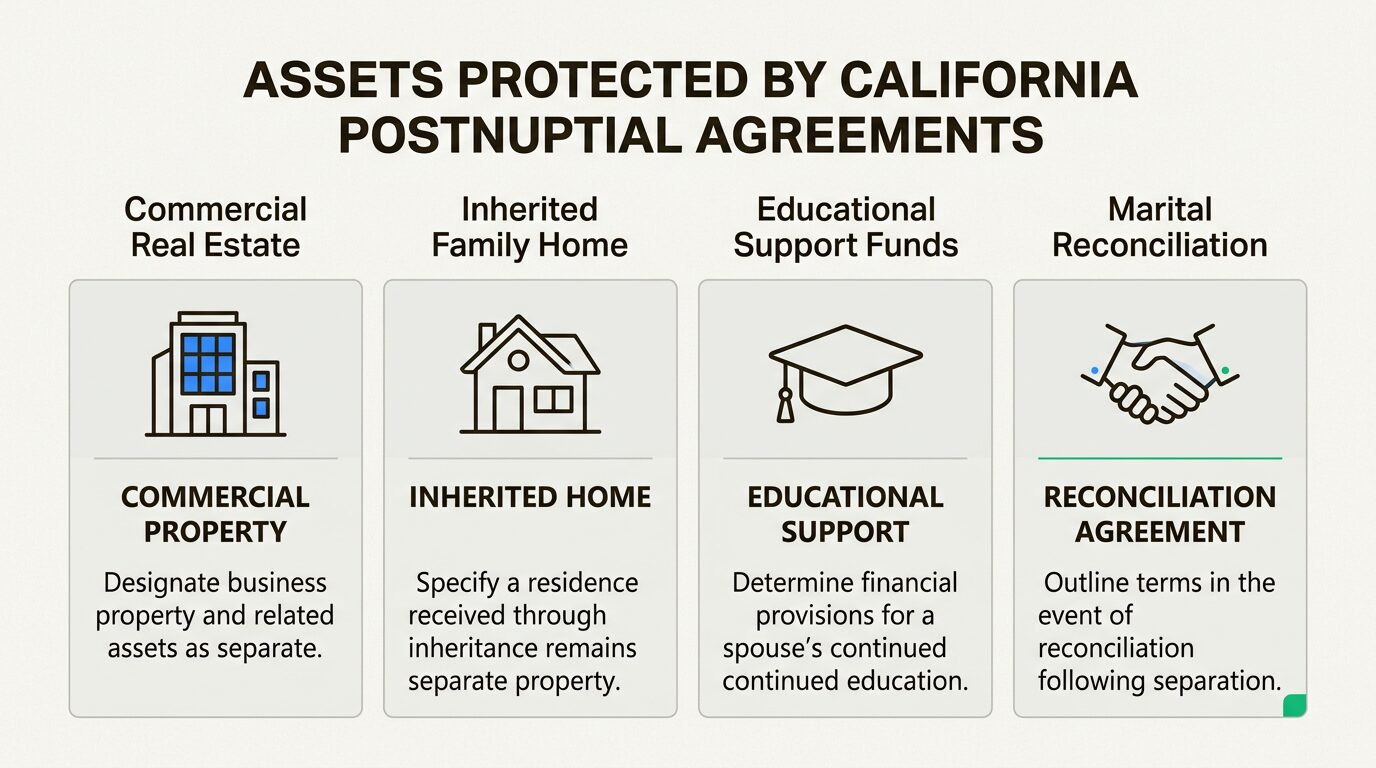
You started a company two years into your marriage, and it’s now worth significantly more than anyone anticipated. Under California law, that business may be treated as community property. Without a postnuptial agreement, your spouse could be entitled to half its value upon divorce, regardless of their actual involvement.
A postnup can clarify ownership percentages, protect the business from division, and establish buyout mechanisms. This is especially critical for entrepreneurs in Silicon Beach or entertainment industry professionals whose ventures can scale rapidly.
Inheritance and Asset Protection
You received a substantial inheritance from a parent, or you’re expecting one. While inheritances are generally considered separate property under California law, they can become “commingled” with community assets over time. If you use inherited funds to renovate the marital home or pay joint expenses, tracing those assets becomes complicated.
A postnuptial agreement provides clear documentation that specific assets remain your separate property, regardless of how they’re used during the marriage.
Career Sacrifices and Support
One spouse gave up their career to support the other’s medical residency, MBA program, or business launch. The supporting spouse made a real economic sacrifice, and a postnup can ensure they receive fair compensation if the marriage ends before they can rebuild their own career.
Revising Existing Prenups
Circumstances change. Family Code § 1614 allows married couples to amend or revoke prenuptial agreements through written postnuptial agreements signed by both parties. We frequently see clients who signed basic prenups years ago but now need to address assets that didn’t exist when they first married: stock options that vested, real estate that appreciated significantly, or businesses that grew beyond expectations.
Marital Reconciliation
Sometimes financial betrayal or trust issues surface during marriage. One spouse discovers the other was hiding debts, spending recklessly, or making unilateral financial decisions. A postnuptial agreement can establish boundaries, require financial transparency going forward, and create consequences for future violations. It’s a tool for rebuilding trust through structure.
What Makes a Postnuptial Agreement Enforceable in California?
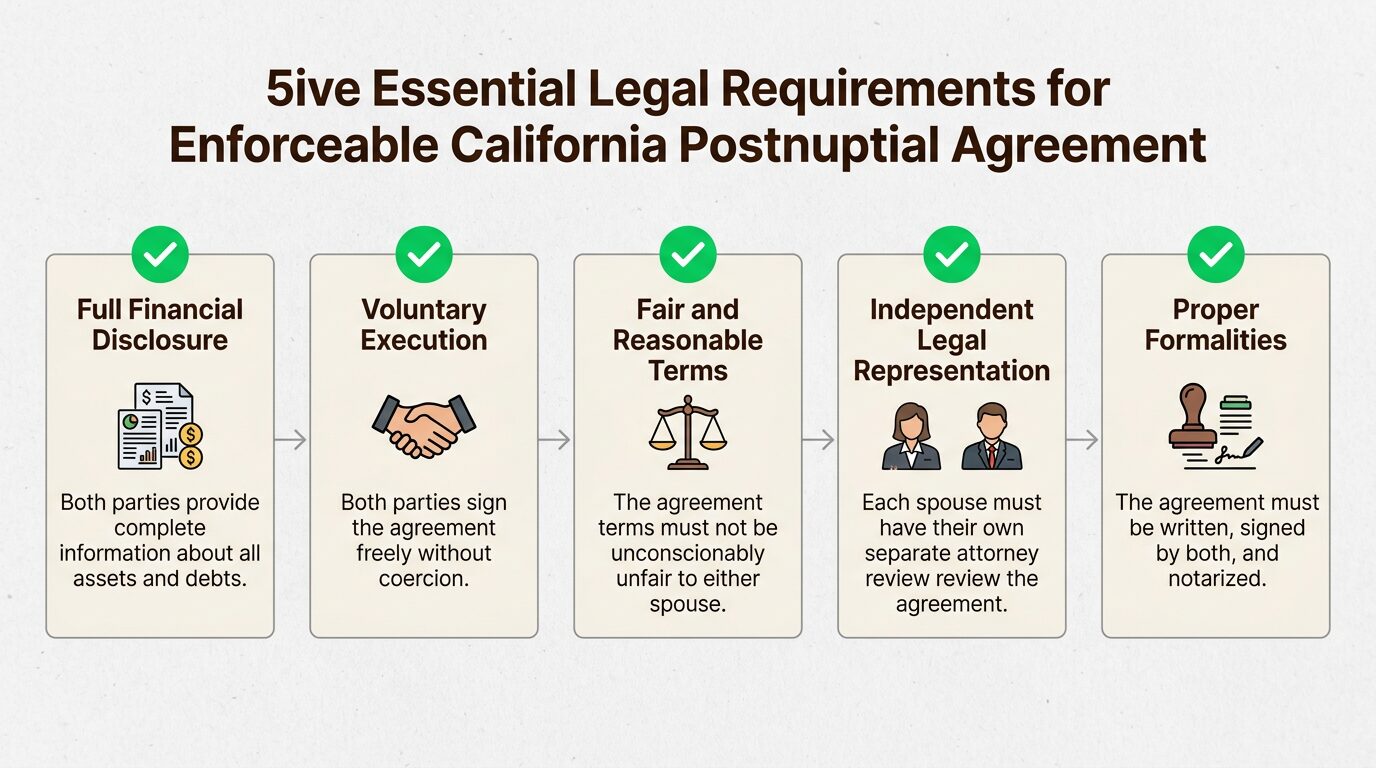
California courts will not enforce postnuptial agreements that fail to meet strict legal standards. The burden of proving validity typically falls on the spouse seeking enforcement. Here’s what you need:
Full Financial Disclosure
Both spouses must provide complete, honest disclosure of all assets, debts, income, and financial obligations. This means:
- All bank accounts, investment accounts, and retirement accounts
- Real estate holdings and their current values
- Business interests and ownership percentages
- Outstanding debts, including credit cards, loans, and tax liabilities
- Anticipated inheritances or future income streams
Hiding assets, undervaluing property, or failing to disclose debts can invalidate the entire agreement. Courts view nondisclosure as a violation of the fiduciary duty between spouses.
Voluntary Execution
The agreement must be entered into freely, without coercion, threats, or pressure. Courts examine:
- Timing: Was the agreement presented during a marital crisis? Shortly before one spouse filed for divorce?
- Circumstances: Was there an ultimatum (“sign this or I’m leaving”)?
- Opportunity for review: Did both parties have adequate time to consider the terms and seek independent advice?
In our experience, agreements signed under pressure rarely survive judicial scrutiny.
Fair and Reasonable Terms
The agreement cannot be unconscionable or extremely one-sided. While parties can agree to unequal divisions, terms that leave one spouse with virtually nothing or create severe hardship are unlikely to be enforced.
Importantly, California law requires courts to reassess fairness at the time of enforcement, not just at signing. An agreement that seemed reasonable when signed may be deemed unfair years later if circumstances have changed dramatically.
Independent Legal Representation
While not legally required for postnuptial agreements (unlike spousal support waivers in prenups, which do require counsel under Family Code § 1612), having separate attorneys for each spouse significantly strengthens enforceability. It demonstrates that both parties understood their rights and received independent advice.
Courts examining a postnup are already asking whether the fiduciary duty was honored. An agreement where each spouse had their own attorney reviewing the terms is a much stronger answer than one where a single attorney drafted the document and both parties signed.
Proper Formalities
- Written agreement: Verbal postnuptial agreements are unenforceable
- Signed by both parties: Both spouses must execute the document
- Notarized signatures: While not strictly required, notarization adds a layer of authenticity and helps defeat claims of forgery or duress
Common Mistakes That Invalidate Postnuptial Agreements
Even well-intentioned agreements can fail if they’re not executed properly. Here are the most common pitfalls we see:
Inadequate disclosure: Failing to disclose all assets, undervaluing property, or hiding debts gives the other spouse grounds to challenge the agreement later. Full transparency is essential.
One-sided terms: Agreements that leave one spouse with virtually nothing or create extreme hardship are more likely to be overturned. Courts look for basic fairness.
Poor timing: Signing shortly before filing for divorce, during marriage counseling, or in the midst of a crisis raises questions about whether the agreement was truly voluntary.
Pressure or coercion: Threatening divorce if the other spouse doesn’t sign, presenting the agreement as a non-negotiable ultimatum, or setting unreasonable deadlines can invalidate the entire document.
Generic templates: Using boilerplate agreements without customizing them for your specific situation often creates ambiguities that courts must resolve, or worse, includes provisions that don’t apply to California law.
No legal counsel: Both parties using the same attorney, or skipping legal review entirely, makes the agreement vulnerable to claims of inadequate representation or conflicts of interest.
Navigating Postnuptial Agreements in Los Angeles
Los Angeles presents unique considerations for postnuptial agreements. The diversity of wealth sources, the concentration of entertainment industry professionals, and the complexity of assets common in this market require specialized expertise.
LA County Superior Court Considerations
When enforcing postnuptial agreements in Los Angeles, cases are heard in LA County Superior Court’s family law divisions. The court applies California’s fiduciary duty standards with particular attention to full disclosure and voluntariness. Local judges are familiar with high-asset cases and complex financial structures, which means they scrutinize agreements carefully.
High-Net-Worth Considerations
Los Angeles couples often have asset structures that go far beyond basic bank accounts and real estate:
- Real estate portfolios: Multiple properties across Beverly Hills, Santa Monica, Brentwood, and other neighborhoods with significant appreciation
- Entertainment industry residuals: Ongoing royalty streams from film, television, music, or creative work that generate income years after the initial project
- Tech equity: RSUs, stock options, and restricted stock from Silicon Beach companies that vest over time
- Closely held businesses: Professional practices, production companies, or startups where valuation is complex
- Trust structures: Family trusts, generation-skipping trusts, and inherited wealth that require careful protection
In our practice at The Marsh Firm, we’ve found that these complex situations require more than template documents. They demand careful valuation, coordination with financial professionals, and precise drafting to ensure enforceability. A postnup that doesn’t properly address how to value a growing business or how to treat unvested stock options may create more problems than it solves.
What Cannot Be Included in a California Postnuptial Agreement
Postnuptial agreements have limits. California courts will not enforce provisions that:
Determine child custody: Courts decide custody based on the child’s best interests at the time of divorce, not predetermined agreements. Any attempt to lock in custody arrangements will be ignored.
Set child support: Parents cannot contract away their children’s right to support. Child support calculations follow statutory guidelines based on income and custody arrangements at the time of divorce.
Encourage divorce: Provisions that appear to incentivize separation, such as penalties for staying married or bonuses for filing for divorce, violate public policy.
Involve illegal activities: Any provisions related to unlawful conduct are unenforceable and may expose parties to legal consequences.
Violate public policy: Courts retain authority to refuse enforcement of any provision that offends public policy, even if both spouses agreed to it.
Getting Started With a Postnuptial Agreement in California
Creating a valid postnuptial agreement requires careful planning, complete financial disclosure, and precise legal drafting. The stakes are too high, and California’s requirements too stringent, to handle without experienced counsel.
At The Marsh Firm, we approach postnuptial agreements with the same strategic precision we bring to complex divorce matters. We work with high-net-worth individuals, business owners, and professionals throughout Los Angeles to create agreements that protect their interests while meeting the legal standards California courts require.
If you’re considering a postnuptial agreement, or if your spouse has proposed one, request a private consultation today. We’ll provide an honest assessment of your situation, explain the legal requirements specific to your circumstances, and help you understand the path forward.
Frequently Asked Questions About Los Angeles Postnuptial Agreements
Can you get a prenup after marriage in California if you both agree to it?
No. By definition, a prenuptial agreement must be signed before marriage. Once you’re married, the only option is a postnuptial agreement, which serves a similar function but operates under different legal standards with heightened court scrutiny.
How long after marriage can you get a postnuptial agreement in California?
There is no waiting period or time limitation. You can create a postnuptial agreement the day after your wedding or decades into your marriage. However, timing matters for enforceability. Agreements signed during marital crises or shortly before divorce filings face greater scrutiny.
Can you get a prenup after marriage California couples use to protect business interests?
While you cannot get a prenup after marriage, California couples can use postnuptial agreements to protect businesses started or grown during marriage. These agreements can clarify ownership, establish valuation methods, and prevent the business from being divided as community property upon divorce.
What makes a postnuptial agreement unenforceable in California?
Postnuptial agreements can be invalidated by fraud or misrepresentation (hiding assets), duress or coercion (signing under pressure), inadequate disclosure, one-sided or unconscionable terms, or lack of voluntary consent. Courts scrutinize postnups more heavily than prenups because spouses owe each other a fiduciary duty.
Do both spouses need lawyers for a postnuptial agreement in California?
While not legally required, having separate attorneys for each spouse significantly strengthens a postnuptial agreement’s enforceability. Independent counsel demonstrates that both parties understood their rights and entered the agreement voluntarily, which helps overcome the presumption of undue influence that courts apply to postnups.
Can a postnuptial agreement override California community property laws?
Yes, a properly executed postnuptial agreement can modify or override California’s default community property rules. Couples can agree to treat certain assets as separate property, establish their own division formulas, or set terms for spousal support. However, the agreement must meet strict enforceability requirements and cannot address child custody or child support.